

By Tylzen Spoke Roofing · Published
In the seamless vs sectional gutters choice, seamless wins for most Southern California homes: each run is formed on site as one continuous piece, so the only joints are at corners and outlets, and there are far fewer places for sealant to fail in summer heat. Sectional gutters, sold in fixed lengths and joined on the house, cost less in materials and are easy to patch, which keeps them useful for short runs, repairs and certain materials like copper half-round.
Here is how the two compare on leaks, appearance, cost and repairs, and when we recommend each one for seamless gutters or a sectional system.
What is the difference between seamless and sectional gutters?
Seamless gutters are made from a coil of pre-painted aluminum, steel or copper fed through a forming machine at the house. The crew measures each eave and cuts a gutter to that exact length. Sectional gutters come from a supplier in standard lengths, typically 10 or 20 feet, and are joined with slip connectors, rivets and sealant.
Both use the same profiles, most often K-style on Southern California homes, and the same hangers, downspouts and outlets. The real difference is how many joints the finished system has.
Want a roofer to look at it?
Call with your address and what you are seeing. We visit same-day or next-day when crews are free.
- 4.9 from 48 Google reviews
- Based on Rosemead Blvd
- Photos and a written quote before work
Seamless and sectional gutters side by side
| Factor | Seamless | Sectional |
|---|---|---|
| Joints | Only at corners, end caps and outlets | Every 10-20 feet plus corners and outlets |
| Leak risk over time | Lower; fewer sealed joints to age | Higher; each seam depends on sealant |
| Appearance | Clean, unbroken line along the eave | Visible seams and connectors |
| Installation | Requires a forming machine and trained crew | Can be assembled from stock parts |
| Upfront cost | Moderate; labor and equipment included | Lower material cost; more joint labor |
| Repair of damaged section | Often means replacing the whole run | Swap one section |
| Materials | Aluminum, steel, copper coil | Aluminum, steel, vinyl, copper half-round |
Do sectional gutter seams always leak?
Not right away. A well-made seam with fresh sealant and rivets is watertight. The issue is what happens over several summers. Aluminum expands and contracts with every hot afternoon and cool night, and that movement works on the sealant at each joint. Once the sealant hardens and cracks, the seam drips, usually right over a walkway or door.
Seamless gutters still have joints at corners and outlets, and those need the same care. The advantage is simply fewer of them: a 40-foot eave might have one seamless run with two end caps, compared with several seams on a sectional system.
How can you tell which gutters your house has now?
Many owners are not sure what is on the house, especially after buying an older home. Five checks from a ladder or the ground will usually tell you:
- Walk each eave and look for joints. Seams every 10 or 20 feet on a straight run mean sectional; joints only at corners and outlets mean seamless.
- Hold a magnet to the gutter face. If it sticks, the gutter is galvanized steel, usually original to a mid-century house; aluminum and copper will not hold it.
- Tap the gutter. Vinyl sounds hollow and flexes under a thumb, while metal rings and holds its shape.
- Look at the hangers. Long spikes through the face with tube ferrules are an older method; hidden hangers clip inside the front lip.
- Check the fascia behind any loose hanger. Soft wood there needs soffit and fascia repair whichever gutter type you choose next.
Steel sectional gutters with rust at the seams are the most common candidates for replacement on post-war homes. Aluminum sectional gutters in good shape can often be resealed and kept.

Seamless gutters pros and cons
Advantages
- Fewer leak points and less sealant to maintain.
- A cleaner look that suits stucco ranch homes and modern remodels alike.
- Custom lengths cut to fit, so there is no awkward short piece at the end of a run.
- Wide color choice from pre-painted coil.
Drawbacks
- Needs an installer with a forming machine; not a weekend project.
- A dent or crushed section on a long run can mean replacing the full length.
- Very long runs need careful expansion planning on hot walls.
When sectional gutters still make sense
- Short runs over a porch, shed or small patio cover where a seamless crew is not already on site.
- Matching an existing sectional system when only one length is damaged.
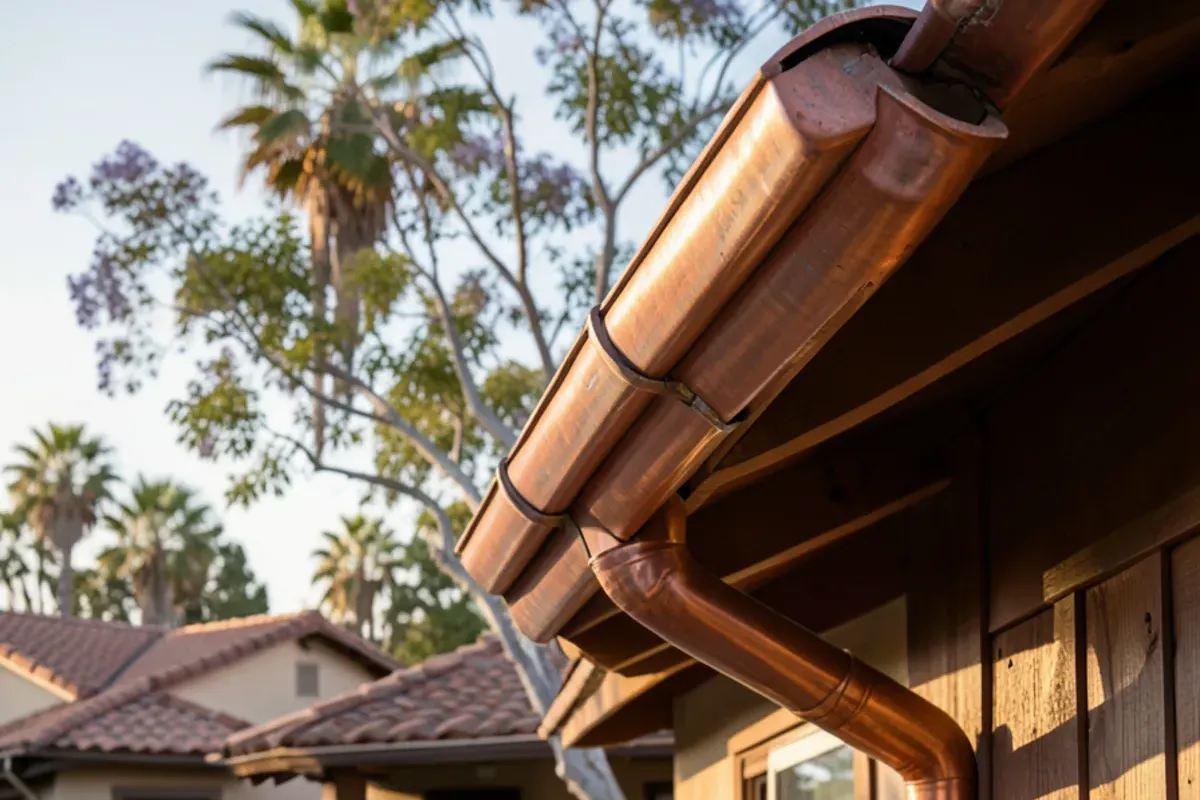
- Copper half-round gutters on historic or Craftsman homes, which are commonly installed in sections with soldered joints.
- Vinyl gutters on detached structures where cost matters most, though vinyl can get brittle in strong sun.
- Temporary or DIY repairs while planning a full replacement.
Soldered copper seams behave differently from sealed aluminum ones. Done well, they are permanent, which is why sectional copper remains a quality choice.
What we see on Rosemead and Temple City homes
Around roofing in Rosemead and in nearby Temple City, many post-war homes still carry sectional galvanized steel gutters from an earlier owner. Point2Homes puts Rosemead's median build year at 1959, and gutters that old usually show the same pattern.
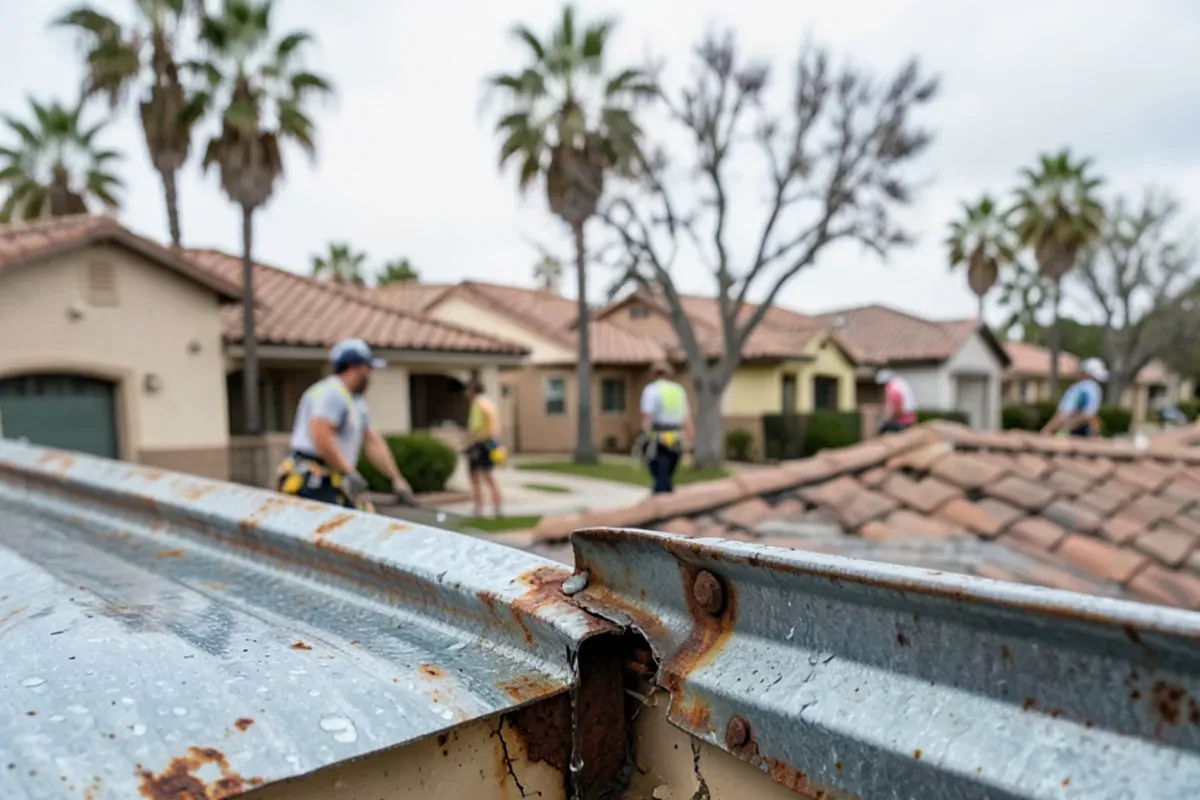
- Rust starting at seams and end caps, where water sits longest.
- Layers of sealant added over the years, each one a little less effective.
- Sections re-hung at different heights, breaking the pitch toward the outlet.
- Mixed materials where a damaged length was replaced with aluminum or vinyl.
When more than a couple of seams leak and the hangers are loose, replacement with seamless aluminum is usually more economical than another round of gutter repair.
The trade-offs nobody mentions on a showroom sample
Seamless runs move. Aluminum grows and shrinks with temperature, and a 50-foot gutter in afternoon sun can change length by roughly half an inch between a cool morning and a hot afternoon. On a very long eave we add an expansion joint, which means even a seamless system carries one deliberate seam where the metal can slide. Skipping it saves a few minutes and leads to buckled runs and popped end caps.
Color is the other catch. Pre-painted coil fades over years in the San Gabriel Valley sun, so a new seamless piece formed to replace one crushed run may look brighter than the rest of the house. Sectional systems have the same problem, but swapping one length draws less attention than a full new run. If you expect to repair rather than replace, keeping a few feet of matching material in the garage is worth it.
Choosing gutter material along with gutter type
Aluminum is the common choice here: it does not rust, it is light on older fascia boards, and it comes in many colors. Steel is stronger against ladders and falling branches but can rust once the coating is scratched. Copper costs the most and develops a patina; it is often chosen for historic homes. Vinyl is inexpensive but less durable in strong sun. Gauge matters as much as metal, so ask what thickness is being quoted for gutter installation.
Profile affects capacity too. A 5-inch K-style gutter holds noticeably more water than a 5-inch half-round, because its flat back and deeper front give it more cross-section. Homeowners who want the half-round look on a Craftsman often step up to a 6-inch half-round, or add a downspout, to keep the same capacity. Half-round also hangs from brackets or rafter-tail straps rather than fascia clips, which matters on homes with exposed rafters and no continuous fascia board.
Picking the right gutter for your house
For most homes, seamless aluminum gives the fewest leaks for the money. Sectional systems earn their place on short runs, copper on period homes and quick repairs. We will measure your eaves, look at the fascia and suggest the type and downspout layout that fits. Call (725) 745-8803 or request a quote for a written, line-by-line price.
Questions readers ask
Are seamless gutters really seamless?
Each straight run is one continuous piece. Joints still exist at inside and outside corners, end caps and downspout outlets. Those are sealed and riveted, and they need checking every year or two, but there are far fewer of them than on a sectional system.
Can a damaged seamless gutter be repaired?
Small dents and leaks at corners can be repaired. A badly bent or crushed run is usually replaced, because there is no seam to separate it at. Since a crew forms the new piece on site to the same length and color, a single-run replacement is usually a short job.
Is it worth replacing sectional gutters that still work?
Not if they drain well, seams are dry and hangers are tight. Replace them when seams leak repeatedly, rust appears, pitch is off or you are reroofing and the drip edge is being replaced anyway. Combining work saves an extra trip and avoids disturbing new roofing later.
Which gutter type holds up better on a tile roof?
Either type can work, since the gutter hangs on the fascia below the tile. What matters more is setting the gutter at the right height under the tile overhang and using strong hangers. Seamless runs still reduce leak points, which helps where the tile edge makes gutters harder to reach for maintenance.
Can a seamless gutter wrap around a corner in one piece?
No. Each straight run is formed separately, and the corner is joined with a factory-made or site-cut miter that is riveted and sealed. Some crews use strip miters, a band of coil over the outside of the joint, to strengthen and hide the seam. Corners carry the most water, so their sealant deserves a look every fall before the November rains.
Sources
Written by Tylzen Spoke Roofing
A roofing contractor on Rosemead Blvd (CA-19) in Rosemead, working on shingle, tile, metal and flat roofs across the San Gabriel Valley. This guide reflects what our crews check on local roofs. Questions about your roof? Call (725) 745-8803.