
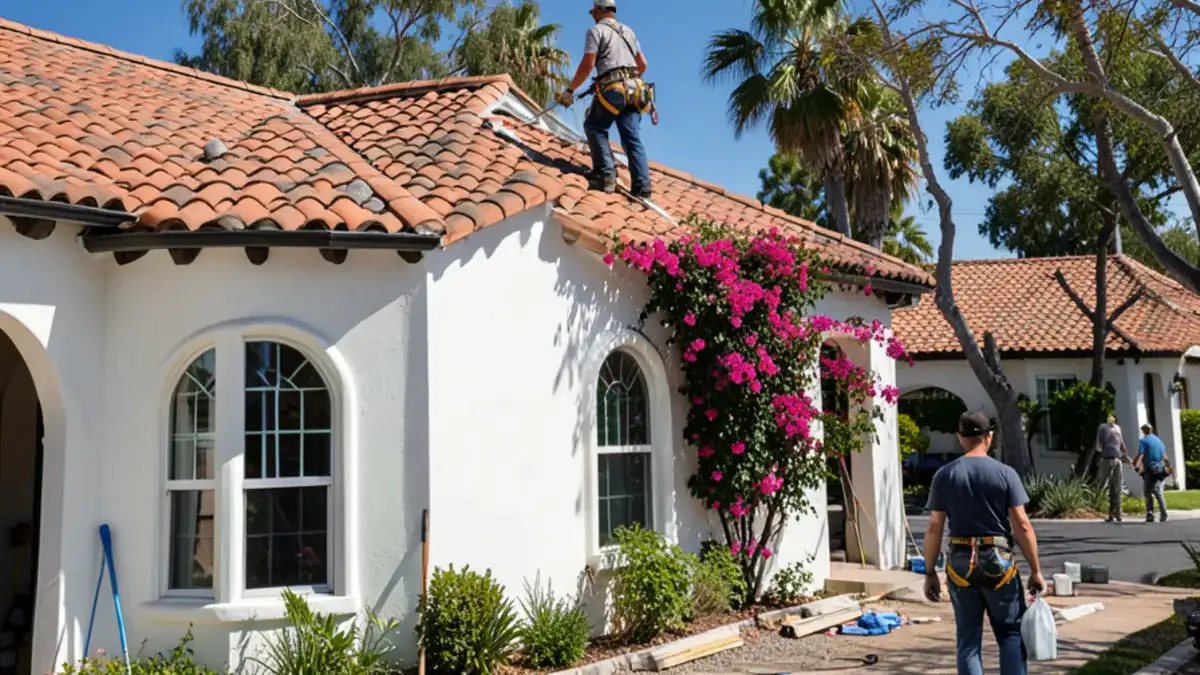
Tile roofing in Rosemead, CA shows up on two kinds of houses: Spanish Revival and Mediterranean homes under clay S-tile or barrel tile, and 1970s-2000s homes under concrete tile. We install new tile roofs, reroof existing ones by lifting the tile and replacing the underlayment below it, and match tile on older roofs. Tile is one of the materials we handle as a roofing contractor in Rosemead, and it calls for different skills and pacing than shingles.
The tile itself rarely wears out. What fails is the underlayment under it, the flashing at walls and valleys, and tiles cracked by foot traffic or falling limbs. Nearly every tile leak we trace starts in one of those places.
Tile roofing in Rosemead, CA: clay, concrete and the profiles between
Clay tile roof
Fired clay keeps its color for the life of the roof and handles heat well. It is more brittle underfoot and costs more than concrete. Two-piece mission barrel and one-piece S-tile are the classic Spanish tile roof profiles on San Gabriel Valley revival homes.
Concrete tile roof
Cement-based tile molded in flat, low-profile and S shapes. It costs less and is very durable, though its surface color can erode over decades, which is why older concrete roofs look chalky. Many hillside and planned-community homes built from the 1970s on carry it.
Lightweight concrete tile
Reduced-weight concrete tile for houses that cannot carry standard tile without framing upgrades.
| Profile | Material | Typical house | Notes |
|---|---|---|---|
| Two-piece barrel (mission) | Clay | Spanish Revival | Pans and covers laid separately; the most labor per square |
| One-piece S-tile | Clay or concrete | Mediterranean and revival homes | Faster to lay than two-piece, with a similar wave |
| Flat or low-profile | Concrete | 1970s-2000s tracts | Many older colors are discontinued |
| Lightweight concrete | Concrete | Shingle-to-tile conversions | Can reduce framing work; confirm with an engineer |
Signs the layer beneath your clay or concrete tile is giving out
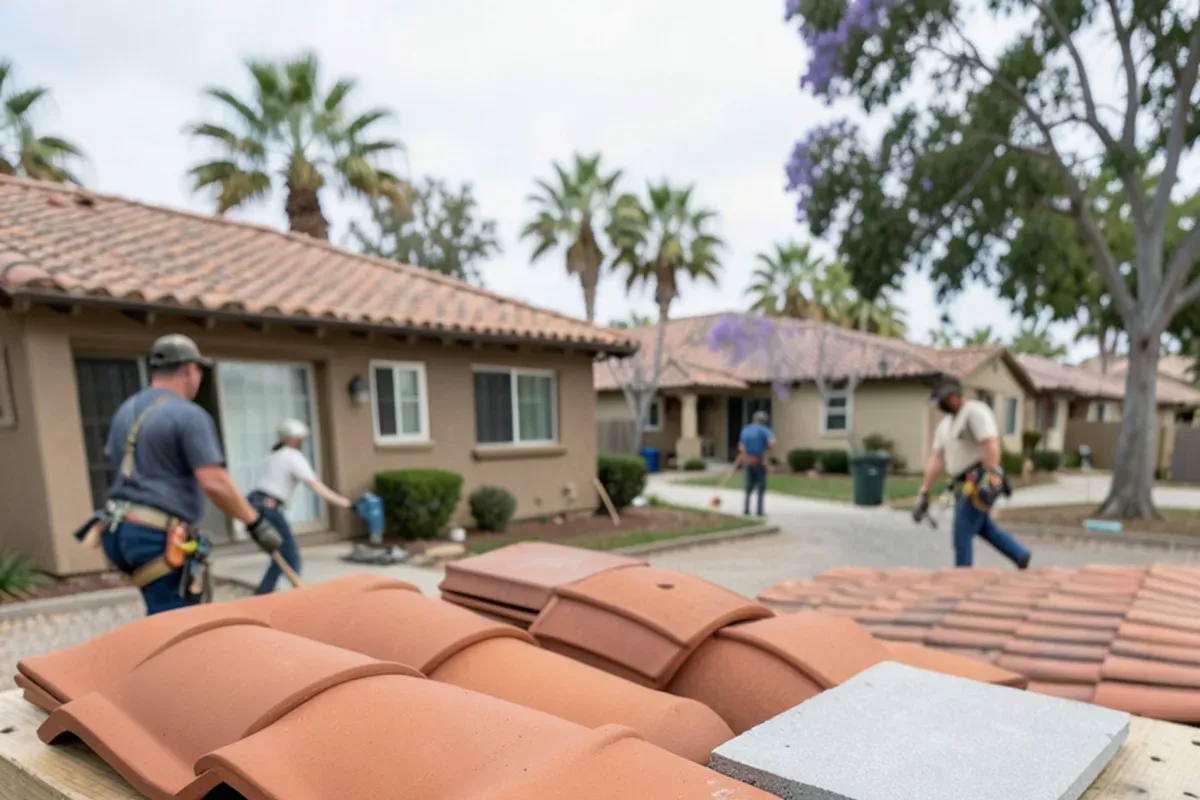
Underlayment under tile is commonly given a service life of about 30 years, while the tile above it can last far longer. Many concrete tile roofs laid across the valley from the 1970s to the 1990s are therefore at or past that mark on their original felt. Heat speeds the aging, since the space under dark tile on a summer afternoon dries felt until it splits along the batten lines.
- Leaf and needle dams from pine, ficus and jacaranda that hold water against the felt behind tiles.
- Tiles slipped or cracked by Santa Ana and downslope winds, which peak October to March, or by limbs like those the January 2025 windstorm brought down.
- Rusted valley metal, and open pans at the eaves where missing bird stop lets pigeons and rodents nest under the first course.
- Mortar-set ridges loosened by seismic shaking and years of heat cycling.
- Gutters that back up under the eave row and rot the bottom edge of the underlayment.
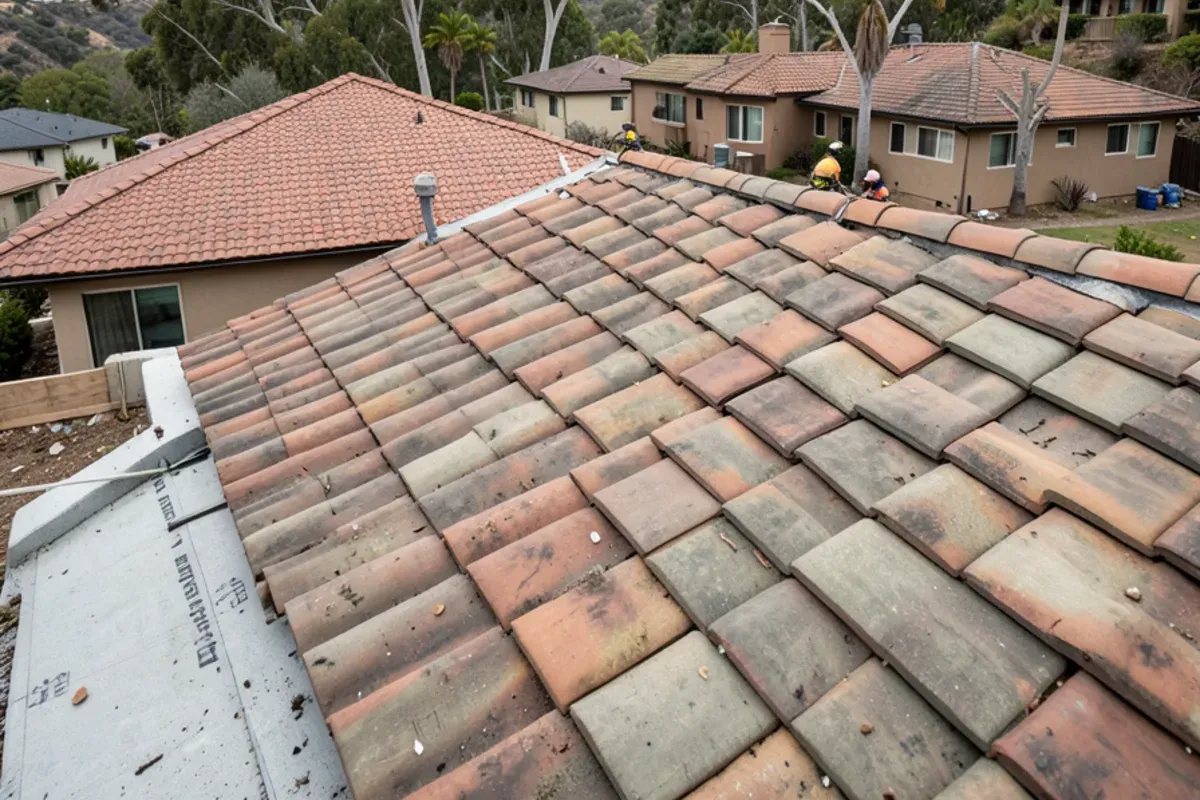
Inside, look for ceiling stains near valleys, chimneys and wall joints, or a musty attic after rain. If lifting tiles reveals dark staining or delaminating plywood, the water has reached the deck and the job grows to include new sheathing.
Switching to tile: framing, weight and code
Tile weighs several times as much as asphalt shingles. A house framed for shingles or shakes may need an engineer's review, and sometimes added rafters or beams, before tile goes on. We flag that during the estimate, and the building department reviews it with the permit.
Weight helps with the energy code. Roofs of 25 lb/ft² or more are among the Title 24 cool-roof exceptions, which covers most tile, though lighter profiles may still need a CRRC-rated color. Confirm the path with the building department; we do that when we apply for the permit.
We fasten field tiles, hips and ridges mechanically to code rather than relying on mortar alone. Shaking like the 1987 Whittier Narrows earthquake, centered just south of Rosemead, is the reason loose mortar-set ridges end up in the yard.
Tile reroofs need a building permit from the city or, in unincorporated areas, from LA County Public Works. California's C-39 Roofing classification covers roof tile, and any job above $1,000 or any job needing a permit calls for a CSLB-licensed contractor; verify every bidder at cslb.ca.gov. In Very High Fire Hazard Severity Zones, such as the Altadena and Sierra Madre foothills, Chapter 7A also requires the gap under profiled tile at the eaves to be fire-stopped, or a 72-pound mineral-surfaced cap sheet over the deck, so embers cannot lodge beneath the tile.
Lift and relay or a new tile roof: which reroof makes sense?
Lift and relay
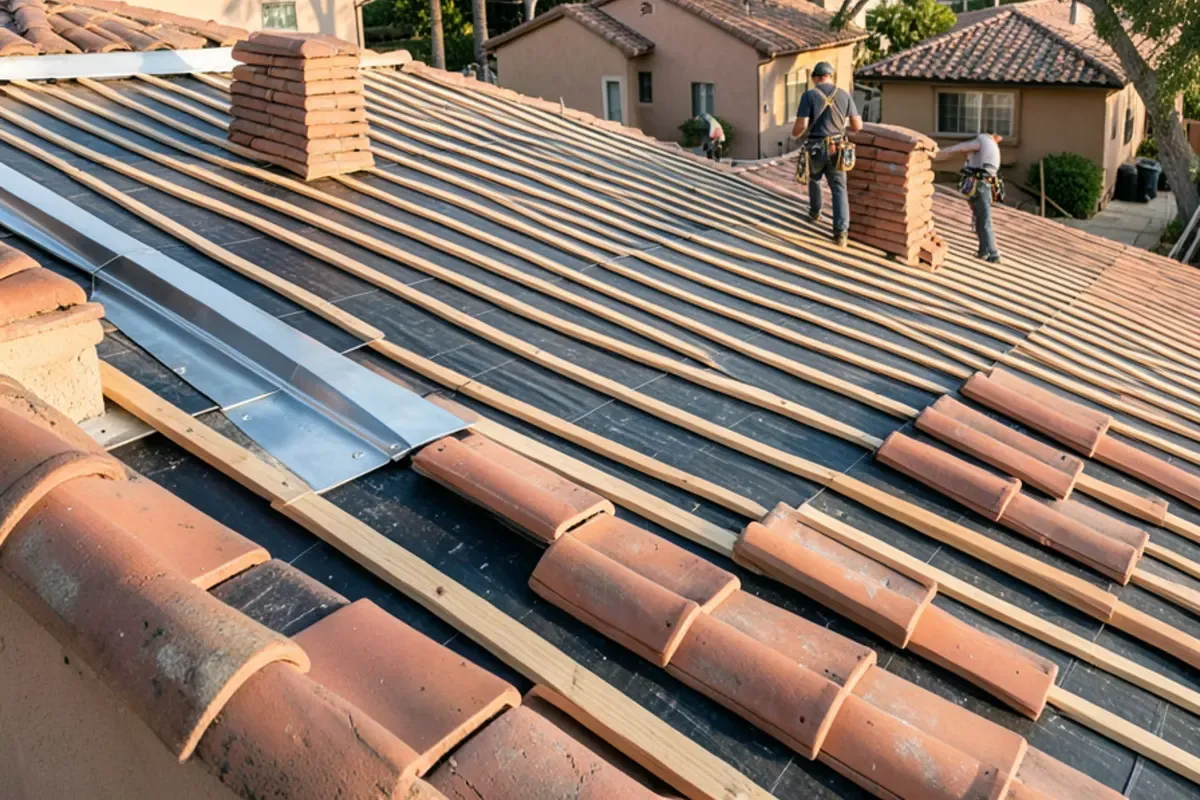
We remove the tiles, stack them on the roof or in the yard, replace the underlayment and flashing, and relay the same tiles with new fasteners. Broken pieces are swapped for matches. It keeps the original look and usually costs less than new tile. The tile underlayment replacement page walks through that job.
New tile
When concrete tile has eroded, old clay has turned brittle, or you want a different profile, new tile goes on over new underlayment and battens.
Spot repair
A few cracked tiles or a single valley leak can be handled as a tile roof repair when the underlayment around it is still sound.
Need tile roofing help this week?
Tell us what you are seeing. We schedule same-day or next-day visits when crews are free and send photos with a written quote.
- 4.9 from 48 Google reviews
- Based on Rosemead Blvd
- Photos and a written quote before work
S tile roofing and barrel tile installation, start to finish
- We inspect from the roof and the attic, count broken tiles and send a written, line-by-line quote.
- We pull the permit and arrange an engineer's review if the framing needs one.
- Plants, walls and walkways are covered, since tile work drops more debris than most jobs.
- Tiles come off and are sorted: sound, cracked, and pieces to set aside for matching.
- Old underlayment is stripped and damaged deck replaced, then a two-ply underlayment goes down with new valley metal and wall flashing.
- Battens, bird stop at the eaves and new pipe flashings go in before tile is laid.
- Tile is relaid with fasteners, hips and ridges are set, and we schedule the final inspection and clean up.
A lift-and-relay on a typical single-story house takes longer than a shingle reroof, often a week or more depending on size, pitch and how many tiles need matching.
Matching discontinued tiles on an older roof
Many concrete colors from the 1980s and 1990s are no longer made, and old clay varies from batch to batch. We start with salvage stock and reclaimed tile from suppliers. When the match is close but not exact, we move original tiles from rear slopes to the front of the house and put the nearest matches where they show least.
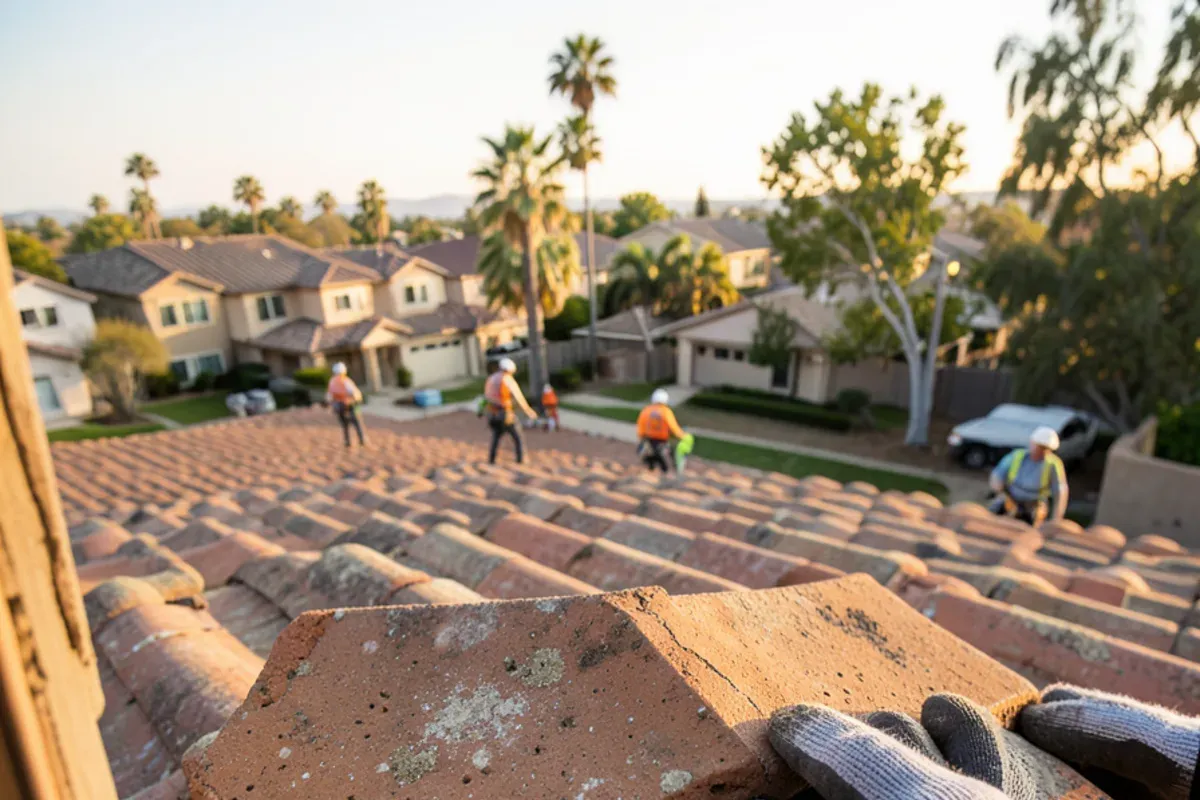
What affects the price of a tile roof in the San Gabriel Valley?
No public calculator gives a dependable planning number for tile reroofs here, so we give you a written quote rather than a borrowed range. The main drivers are:
- Profile and material: two-piece clay barrel takes the most labor.
- Lift and relay versus new tile.
- Breakage and the cost of sourcing matches.
- The underlayment system and the amount of valley and wall flashing.
- Any framing upgrade the engineer calls for.
- Pitch, stories and the permit.
Ask about payment options once you have the quote in hand.
Why owners of tile homes call Tylzen Spoke
- A 4.9-star average on Google from 48 reviews, as of November 2026.
- Every quote comes with photos of the findings and lists the permit and any deck work as separate lines.
- Reviewers mention plain explanations of lift-and-relay versus new tile, with no pressure either way.
- Our Rosemead Blvd base keeps tile homes across the valley close by.
Market examples include Westlake Royal (formerly Boral) and Eagle Roofing for concrete tile, and Ludowici among clay makers. We mention them so you can research; the right product depends on profile, color and weight.
Manufacturer coverage depends on the tile and underlayment you choose, and our workmanship terms are written into the contract. Ask for both in writing, along with whether they transfer at sale.
We work on tile homes in San Marino, Arcadia and Monterey Park, as well as Rosemead. If tile is too heavy for your house, metal roofing includes tile-profile stone-coated panels, and slate and synthetic slate roofing suits older estate homes.
What customers say on Google
4.9★ from 48 Google reviews (checked Nov 2026)
“We've had a couple of experiences with this roofing company, and both have been great. The first time, we had a leak around an old roof vent. Their team replaced the vent, sealed everything up, and put our cement tile shingles back in place. The work was finished quickly, looked good, and the price was reasonable. …”
“A recent strong wind loosened a shingle on my roof in Rosemead. It took just one call, and Tanner came out the very next day to help. While we talked, I mentioned how thankful I still am for the excellent roofing work the crew did years ago, which has continued to hold up very well. …”
“Five stars all the way. From William’s first visit and walkthrough with us to Brandon’s excellent follow-up, this roofing company was outstanding and professional. We always felt comfortable—never pushed or promised more than they could deliver. …”
Where we handle tile roofing
- Rosemead
Spanish Revival homes under clay S-tile sit among Rosemead's shingle ranch houses, and most need a lift-and-relay rather than new tile.
- San Marino
Period revival homes carry clay barrel tile, where close color matching and careful foot traffic matter as much as the underlayment.
- Arcadia
Large homes under concrete and clay tile have long valley runs and hip ridges that need mechanical fastening, not mortar alone.
- Pasadena
Spanish Colonial Revival houses use two-piece clay barrel tile, and broken pieces must be matched to profiles nearly a century old.
- Altadena
Foothill streets in Very High fire zones need Class A tile assemblies with fire-stopped eaves, including homes rebuilt after the Eaton Fire.
- Hacienda Heights
Hillside tracts built from the 1970s on carry concrete tile whose original felt underlayment is now at or past its expected life.
- Rowland Heights
Concrete tile in hillside neighborhoods often comes in discontinued colors, so salvage matching is priced into each lift-and-relay quote.
- Walnut
Planned-community homes under concrete tile usually need underlayment and valley metal work long before the tile itself shows wear.
Tile Roofing questions
Is my house framed to carry a tile roof if I switch from shingles?
Not always. Tile weighs several times as much as asphalt shingles, and houses framed in the 1950s for shingles or shakes may need added rafters or beams. We check rafter size and spacing in the attic, and when the answer is unclear we recommend an engineer's review before quoting. Lightweight concrete tile can reduce the load.
Clay or concrete tile: which suits a San Gabriel Valley home?
Clay suits Spanish Revival and Mediterranean homes, holds its color and copes well with heat, but it costs more and breaks more easily underfoot. Concrete suits later tract and planned-community homes and costs less, though its color can fade. Both shed rain well as long as the underlayment beneath them is sound.
Can you match discontinued tiles on an older roof?
Usually close enough that it does not show from the street. We source salvage and reclaimed tile, and when no perfect match exists we move original tiles to the front slopes and put the nearest matches on the back. We lay samples on the roof for you to see before we commit.
Why does my tile roof leak when no tiles look broken?
Because tile is not the waterproof layer. The underlayment beneath it is, and years of valley heat dry it out until it cracks. Water then runs under the tile to the deck. Leaf dams behind tiles and rusted valley metal make it worse, which is why we lift tiles to look underneath.
Can I walk on my tile roof to clean gutters or hang lights?
We advise against it. Clay and concrete crack under point loads, and the cracks often go unnoticed until rain. If you must go up, step only on the lower third of each tile, where it overlaps the one below. A crack made in December tends to become a leak in February.
Do tile roofs need a cool-rated color under Title 24?
Many do not, because roofs weighing 25 lb/ft² or more fall under an exception, and most tile qualifies. Lightweight tile may not. Other exceptions, such as R-38 ceiling insulation or an attic radiant barrier, can also apply. We confirm the path with the building department before you settle on a color.