
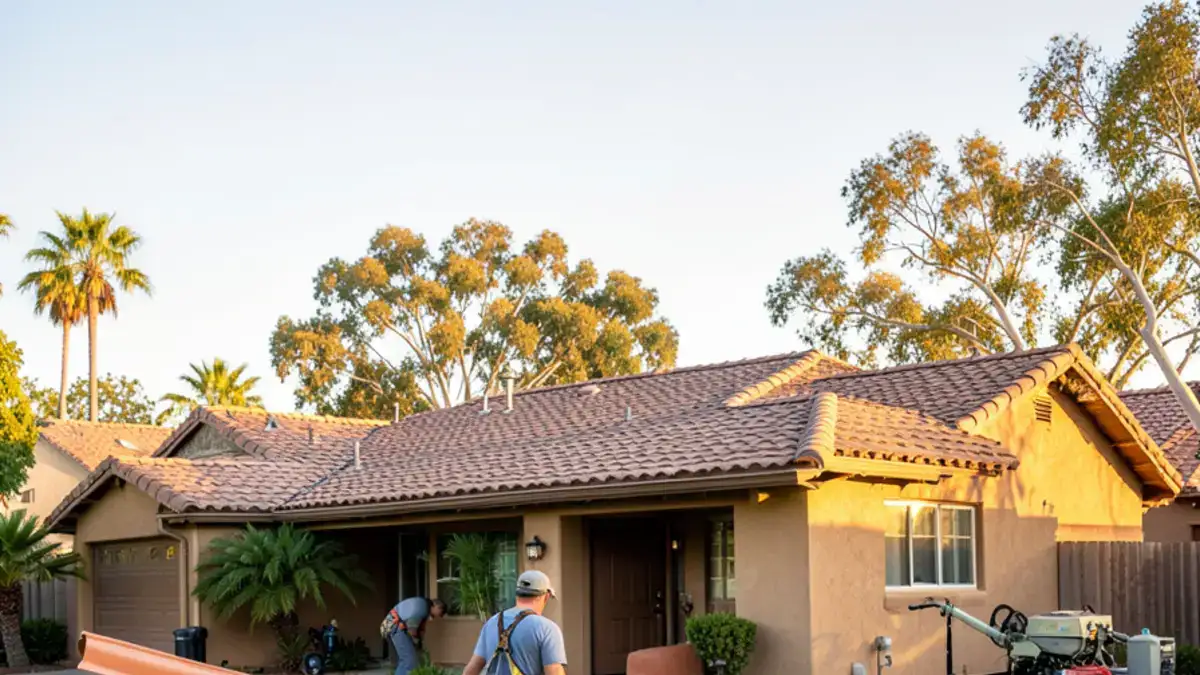
Seamless gutters in Rosemead are formed at the house from a roll of painted aluminum coil, cut to the exact length of each eave and hung in one piece. With no joints every 10 feet, there are far fewer places for water to drip or for sealant to dry out in summer heat. They are the most common choice in our Rosemead rain gutter work, on everything from 1950s ranch homes to newer two-story houses.
The trade-off is that a seamless gutter is only as good as the corners, outlets and hangers that remain. Those details decide whether it stays leak-free, and they are what this page covers.
How seamless aluminum gutters are made on site
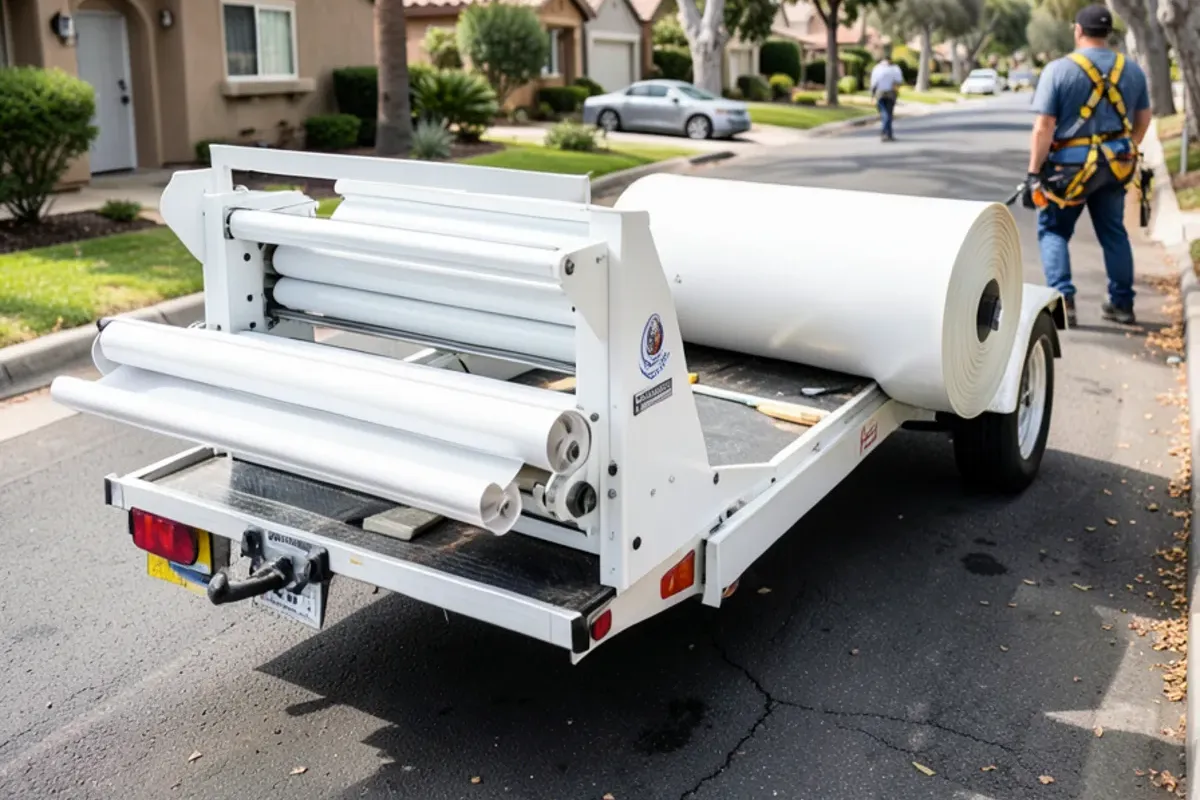
A seamless gutter starts as a flat coil of aluminum, usually .027 or .032 inch thick with a baked-on paint finish. The coil feeds through a portable roll-forming machine that bends it into a K-style profile as it comes out. We measure each run at the house, form it to length, and carry it to the wall in one continuous piece.
Sectional gutters, by contrast, come from the store in 10-foot lengths joined with slip connectors and sealant. A 40-foot eave has three of those joints, and each is a future drip. Seamless runs remove them.
There are practical limits. Very long runs are hard to carry and hang without kinking, and aluminum grows and shrinks as afternoon sun gives way to cool nights. On large homes we may split a long eave at a downspout so the metal has room to move.
What a seamless job covers
- Measuring each eave and forming every run to that length at the curb.
- Choosing coil thickness and color, both named on the quote.
- Miters, end caps and drop outlets riveted and sealed from inside.
- Hidden hangers screwed into solid fascia along each run.
- Downspouts, elbows and straps in the same coil color.
- Removal of the old sectional system and its loose spikes.
Why sectional gutters leak on Rosemead homes
Store-bought sectional gutter joins at a slip connector every 10 feet, so a 100-foot perimeter carries roughly nine seams before counting corners. Each one depends on sealant, and Rosemead summer afternoons in the upper 80s followed by cool nights flex those joints daily until the bead lets go. On many of the city's 1950s ranch homes the gutters were patched one section at a time, so the joints rarely match.
- Drip lines or rust-colored stains on the stucco at regular 10-foot intervals.
- Roofing cement or tape wrapped over the connectors.
- Joints that open a little in afternoon sun.
- A seam that still drips after a fresh cleanout.
Choosing between 5 inch and 6 inch seamless gutters
A 5-inch K-style is the standard on single-story homes with moderate pitch, and it pairs with a 2x3 downspout. A 6-inch K-style carries noticeably more water and pairs with a 3x4 downspout, which has twice the opening area of a 2x3.
| 5-inch | 6-inch | |
|---|---|---|
| Typical downspout | 2x3 inch | 3x4 inch |
| Best fit | Single-story, moderate pitch, short runs | Large or steep roofs, two-story walls, tile, valleys |
| Coil width | 11 7/8-inch coil | 15-inch coil |
| Look on a low eave | Proportional | Can look heavy on a narrow ranch fascia |
| Under trees | Outlets clog sooner | Wider trough and larger outlets clog less often |
We size from the roof plane feeding each run, not the house as a whole. It is common to hang 6-inch gutter on the back of a home below a valley and 5-inch along a simple front eave.
How are seamless gutter corners and outlets sealed?
Corners are where seamless systems leak. An inside or outside miter joins two runs, either as a factory box miter or a strip miter cut and folded from the same coil. Either way, the joint is riveted and then sealed from inside the trough with a gutter sealant made to stay flexible, never roofing cement that cracks.
- Cut the outlet hole from inside the trough, sized to the downspout.
- Set the drop outlet in sealant with rivets, so its flange sits flat and no lower lip holds water.
- Rivet and seal the end caps and miters, then tool the sealant so water flows over it, not against it.
- Water-test every joint before the downspouts go on.
Many seamless leaks we are called to fix trace back to an outlet that sits proud of the gutter floor and leaves a puddle behind it, or to sealant smeared on the outside of a joint instead of the inside.
Need seamless gutters help this week?
Tell us what you are seeing. We schedule same-day or next-day visits when crews are free and send photos with a written quote.
- 4.9 from 48 Google reviews
- Based on Rosemead Blvd
- Photos and a written quote before work
Seamless gutter installation, start to finish
- Measure: every eave, corner and planned downspout, plus the fascia and the edge metal on the roof.
- Quote: a written scope listing footage by size, miters, outlets, downspouts and any wood repair.
- Remove: the old system comes down, along with spikes and loose nails left in the fascia.
- Prepare: rotted fascia is replaced, and the drip edge is checked so the gutter back can tuck under it.
- Form and hang: runs are formed to length at the curb, pitched toward outlets and fastened with hidden hangers.
- Seal and test: miters and outlets are sealed from inside, each run gets a hose test, and the yard is cleaned.
A single-story house is typically done in one day. If your roof is being replaced, schedule the gutters after the new drip edge goes on so the system fits the finished roof line.
Permit and license checks for seamless work
Seamless gutters hung on their own seldom need a building permit. Inside the city, the Rosemead Building and Safety Division makes that call, and LA County Public Works does in unincorporated areas like South San Gabriel. When the gutters follow a reroof, the roof permit covers them. Most seamless crews work under a CSLB C-43 Sheet Metal or C-39 Roofing license, and either can be confirmed at cslb.ca.gov.
How is seamless gutter cost calculated?
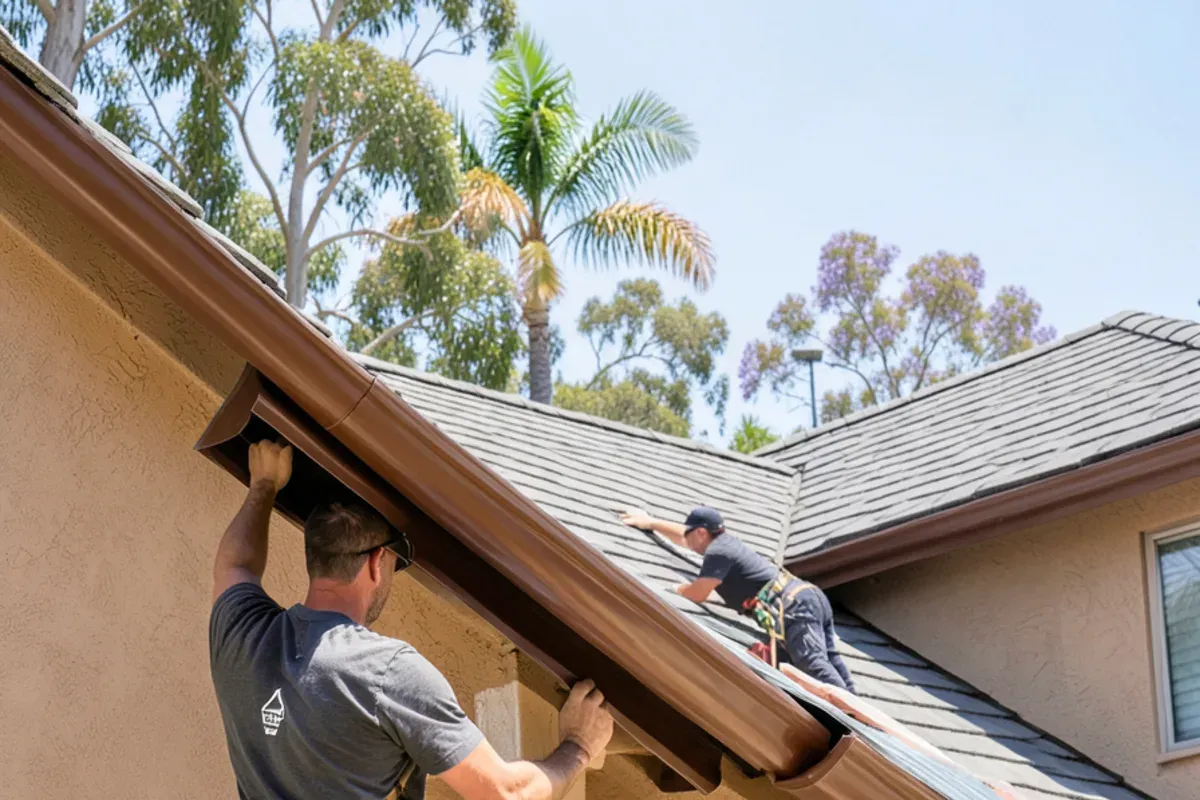
Seamless gutter cost is figured by the foot of formed gutter plus each miter, outlet, end cap and downspout. Footage alone does not tell the story, so we price after measuring.
- Miter count: a house with many inside and outside corners costs more than a simple rectangle.
- Size and coil thickness: 6-inch and .032-inch coil cost more than 5-inch and .027-inch.
- Height and access, including second-story walls and narrow side yards.
- Fascia repair, quoted per board once the old gutter is off.
- Guards, extensions and drain lines added to the system.
When you compare seamless quotes, check that each one names the coil thickness, the hanger type and spacing, and whether haul-off of the old gutters is included. A lower number often leaves one of those out.
Ask about payment options when seamless gutters are part of a reroof or a larger exterior project. For a side-by-side look at both systems, read seamless vs sectional gutters.
Custom length gutters, upkeep and coverage
Because each run is formed to its own measurement, a crushed section can be replaced with a new piece in the same color and length. Keep the coil color name from your quote for that day.
Seamless gutters still collect debris. On homes under pines, sycamores or jacarandas, adding gutter guards cuts down on cleanouts. Without them, book gutter cleaning and minor repairs each fall before the first storm.
Painted aluminum coil is sold by several manufacturers, Englert among them, and your quote names the coil maker and color so you can check the finish specs yourself. The coil maker sets the terms for paint and metal, which differ by product line, and the terms on our labor are written into the contract you sign. Have both put in writing, and check whether a buyer would inherit them.
Why Rosemead homeowners pick Tylzen Spoke for seamless gutters
- Our shop sits on Rosemead Blvd, so a measuring visit anywhere in the valley is a short trip.
- Photos of your current gutters, fascia and roof edge arrive with a line-by-line written quote.
- Reviewers mention crews that show up when promised and protect landscaping while they work.
- Reviewers also say crews came back promptly when a detail needed another look.
- A 4.9-star Google average across 48 reviews, counted in November 2026.
We form and hang seamless gutters throughout the area, including Arcadia, East San Gabriel and West Covina, as well as Rosemead itself.
What customers say on Google
4.9★ from 48 Google reviews (checked Nov 2026)
“Five stars all the way. From William’s first visit and walkthrough with us to Brandon’s excellent follow-up, this roofing company was outstanding and professional. We always felt comfortable—never pushed or promised more than they could deliver. …”
“We had a great experience getting a new roof, gutters, and fascia flashing installed, and the finished work really shows. Everything looks clean, solid, and well done, and the whole roofing project felt organized from start to finish. …”
“Tylzen Spoke Roofing did a great job on my older home. They installed new fascia, soffits, and roof drainage, and also handled the window work as part of the full exterior project. The crew finished everything quickly, kept the job moving, and cleaned up all debris when they were done. …”
Where we handle seamless gutters
- Rosemead
Ranch homes with simple rectangular eaves, where one seamless run per side replaces several sectional joints.
- Arcadia
Larger two-story homes with long eaves, where seamless runs are split at a downspout to allow for expansion.
- East San Gabriel
Post-war single-story tracts where 5-inch seamless aluminum replaces old sectional gutters jointed every 10 feet.
- West Covina
Hillside tract homes with long back eaves, where 6-inch seamless runs carry water to a downspout at each end.
- Temple City
Newer two-story rebuilds where seamless 6-inch gutters are formed in a coil color matched to the trim.
- Montebello
Hillside and flat streets alike, where seamless runs end the joint drips that streak stucco walls.
- Covina
1950s and 1960s single-story homes where seamless aluminum replaces galvanized steel gutters rusting at the seams.
- La Puente
Compact post-war stucco homes where 5-inch seamless aluminum fits a low fascia without looking heavy.
- Diamond Bar
1970s-2000s hillside tracts with concrete tile roofs, where wider seamless troughs catch the tile overhang.
More places we handle seamless gutters
Seamless Gutters questions
Are seamless gutters worth it over sectional gutters?
For most homes, yes. A sectional system has a joint every 10 feet, and each one relies on sealant that hardens through summers in the upper 80s. Seamless runs keep joints to the corners and outlets, so there is less to maintain and less to leak. Sectional still makes sense for short runs on sheds, patio covers or where a matching profile is no longer made.
Which gutter width is right for my house?
Most single-story homes here are fine with 5-inch gutters. Choose 6-inch if a valley empties into a short stretch of gutter, if the roof is steep or tiled, or if the wall is two stories tall. During the visit we look for overflow stains on the siding and fascia, since they show where the current gutter is too small.
What keeps the corners of a seamless gutter from leaking?
Careful joinery. Miters are riveted, then sealed on the inside of the trough with a flexible gutter sealant so water runs across the joint rather than into it. Outlets sit flush with the gutter floor so no water pools. When an old corner leaks, the fix is usually to clean it to bare metal and reseal it properly.
Can one damaged piece of a seamless gutter be replaced?
Yes. Depending on where the dent or crush sits, we either replace the whole run in matching coil or cut in a new length with a sealed joint. Replacing the full run is often the cleaner fix because the gutter stays seamless, and on a typical eave the material difference is small.
Is any eave too long for a single seamless run?
Occasionally. Runs longer than about 40 feet usually get a downspout at each end, and very long eaves on larger homes may be split so the aluminum can move with temperature swings. We place that break at a downspout or corner, where it is easy to reach and hard to notice from the street.