
By Tylzen Spoke Roofing · Published
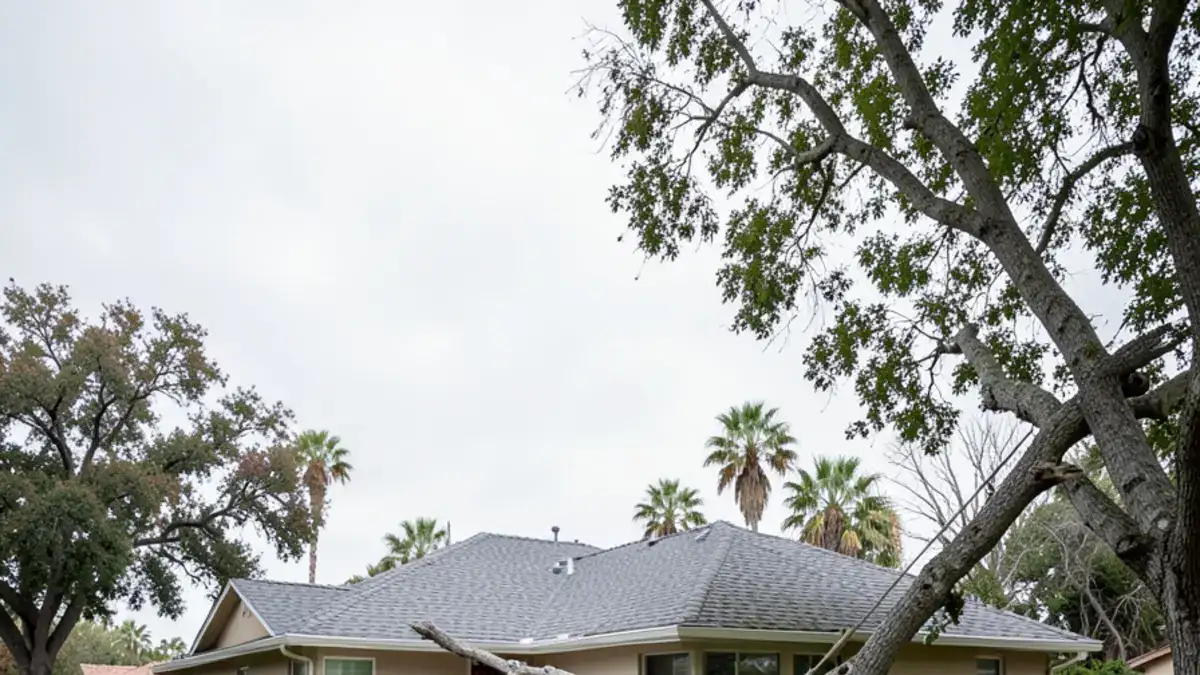
If a tree fell on your roof, here is what to do: get everyone out of rooms under the impact, stay away from any downed wires, photograph the damage before anything is moved, and call a tree service and a roofer to work together. The tree comes off first, the roof gets tarped right after, and framing repairs follow once the damage has been measured.
This guide is for San Gabriel Valley homeowners dealing with the aftermath of wind, saturated soil or a failed limb. It covers safety, insurance photos, what happens during removal and the hidden structural damage that a fallen tree roof damage repair has to address.
Is it safe to stay in the house?
Treat every wire touching the tree or the house as live. Keep people and pets well away, and call 911 and Southern California Edison. Do not try to move branches off a line, even with a wooden pole.
- Leave the house and call 911 if you smell gas, see sparks or hear crackling.
- Keep everyone out of rooms where the ceiling is cracked, sagging or open to the sky.
- Watch for doors or windows that suddenly stick near the impact, a sign the framing has shifted.
- Turn off circuits that feed the damaged rooms if you can reach the panel from a dry, safe spot.
Want a roofer to look at it?
Call with your address and what you are seeing. We visit same-day or next-day when crews are free.
- 4.9 from 48 Google reviews
- Based on Rosemead Blvd
- Photos and a written quote before work
First steps after a tree hits your roof
- Photograph and video the tree on the house from every side you can safely reach, plus interior damage, before anything moves.
- Call your insurance company to open a claim and ask whether they want to inspect before removal.
- Hire a tree service with crane or rigging experience to lift the weight off the structure in sections.
- Have a roofer on site or right behind the tree crew to tarp any opening the same day it is exposed.
- Move belongings out of affected rooms and start drying anything that got wet.
- Schedule a full inspection of decking and framing once the roof is clear.
Who removes the tree, and why coordination matters
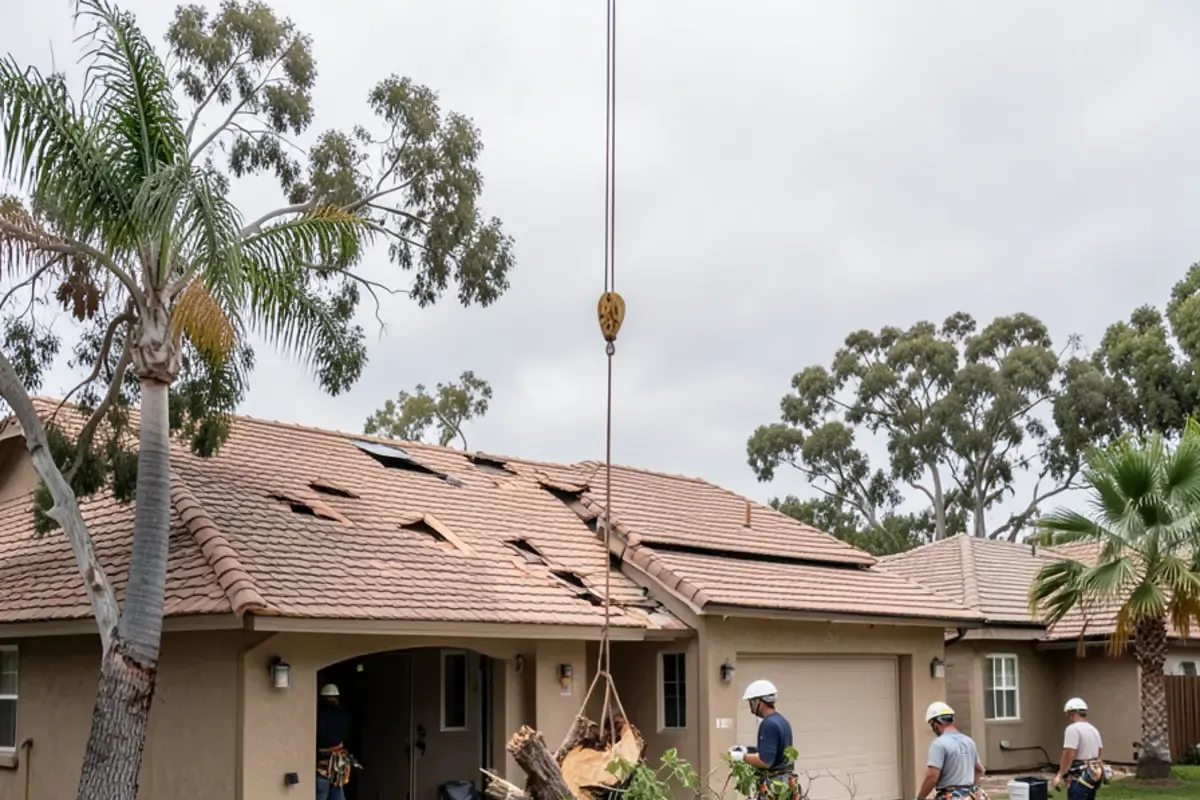
Tree removal is a separate trade from roofing. A qualified tree crew rigs the trunk and big limbs so they come off without dropping again onto the roof, often with a crane for large trees. A roofer should not be cutting a loaded trunk, and a tree crew usually does not tarp.
The handoff is where homes take extra damage. If the tree comes off late in the day and nobody covers the hole, an overnight shower can soak the attic. We coordinate timing with the tree crew so an emergency roof tarp goes on as soon as the opening is clear.
How do you check a tree crew before they start cutting?
After a big wind night, door-knockers with chainsaws show up fast. A tree resting on a house is the most dangerous removal there is, so a few minutes of checking is worth it even when you want the weight off now.
- Look up the license at cslb.ca.gov. Since January 1, 2024, CSLB issues tree work licenses under the C-49 Tree and Palm classification; crews licensed earlier may still hold the older C-61/D-49 Tree Service class.
- Ask for proof of workers' compensation and liability coverage, and confirm the policy is current. Tree work is high-risk, and an injury on your property is a problem you do not want.
- Ask how they will rig the trunk off the roof: crane, rope lowering or both. A crew that plans to cut and let pieces fall is the wrong crew for a tree on a house.
- Get the scope in writing, including whether stump grinding, debris haul-off and cutting the wood to firewood length are included.
- Tell them a roofer is coming right behind them, and agree on who calls whom when the opening is clear.
An ISA Certified Arborist is a separate credential worth asking about when you also want an opinion on whether nearby trees are safe to keep. Insurance adjusters often want the removal invoice itemized apart from roof work, so ask both trades for separate paperwork.
What damage is hidden under a fallen tree?
The visible hole is rarely the whole story. Impact loads travel down through the roof structure, and a limb that bounced off can still crack a rafter.
| Component | Signs of damage | Typical repair |
|---|---|---|
| Roof covering | Torn shingles, cracked or shattered tiles, punctures | Replace the damaged section and blend with existing roof |
| Decking | Holes, cracked sheathing, sag between rafters | Cut out and replace sheets |
| Rafters or trusses | Splits, breaks, bowing, connector plates pulled out | Sister, brace or replace members; may need an engineer |
| Ridge and fascia | Bent ridge line, crushed fascia or gutters | Rebuild the edge and rehang gutters |
| Ceiling below | Cracked drywall, sagging joists, wet insulation | Interior repair after framing is sound |
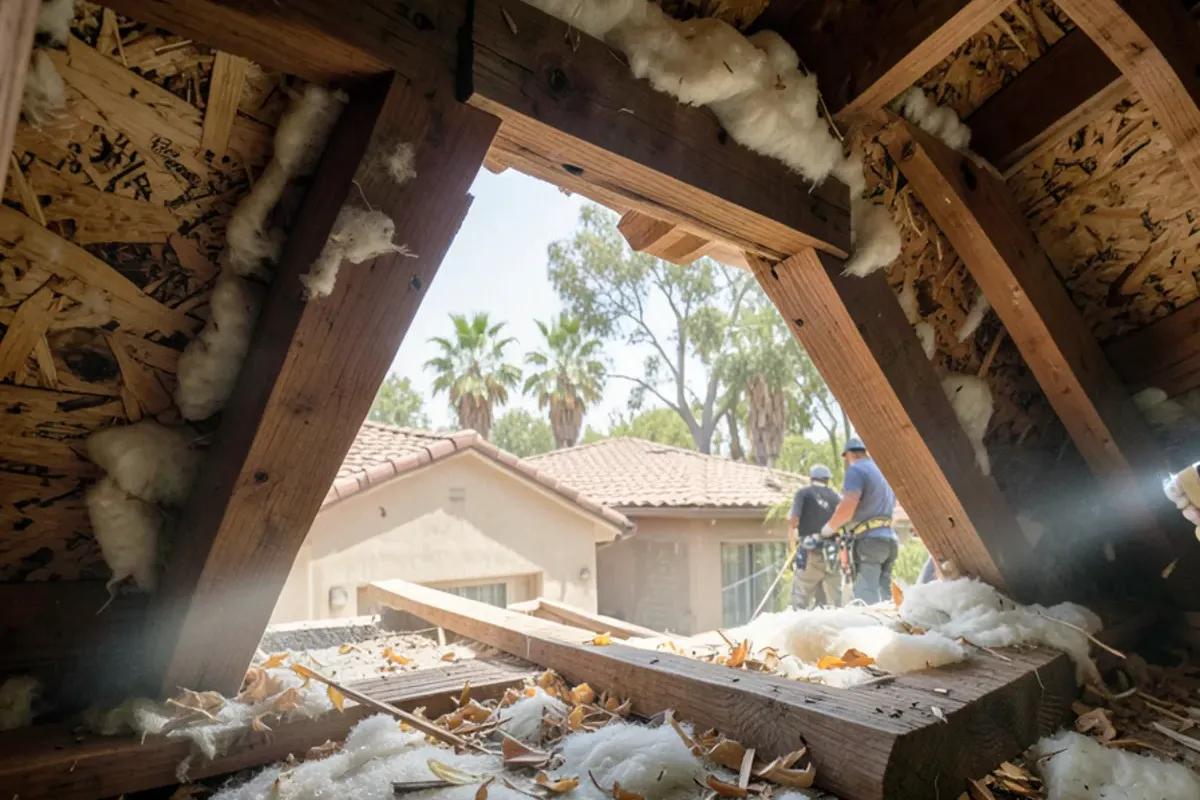
Framing repairs usually need a building permit from your city or, in unincorporated communities, from LA County Public Works. When framing work needs a permit, we file for it and book the inspection.
How insurance usually handles a tree on the house
Many homeowners policies cover damage when a tree falls on a covered structure, often regardless of whose yard it grew in, and some cover the cost of removing the tree from the structure up to a set limit. Removing a tree that fell in the yard without hitting anything is often not covered. Read your own policy, because terms vary.
We document the roof and framing damage with photos and a written scope, and we can meet the adjuster on site to walk through it. Negotiating the settlement is outside the roofer's role; that belongs to the homeowner or a public adjuster with a state license.
What we see after trees and limbs hit SGV roofs
Neighborhoods with older, taller canopies take most of the strikes. Mature trees shade many homes in Temple City and large lots across roofs in Arcadia, and the January 2025 windstorm brought trees down across the foothill side of the valley. Winter rain that saturates the soil before a wind event makes uprooting more likely.
Our crews often find secondary damage away from the main impact: tiles cracked where small branches whipped across them, gutters torn loose, and vent caps knocked off. On post-war homes, original rafters are often smaller than modern framing, so even a moderate limb can crack one. We check the whole roof, not only the obvious hole, and we look at nearby trees with limbs hanging over the house so you can ask an arborist about trimming before the next wind season.
Wait for the adjuster or remove the tree now?
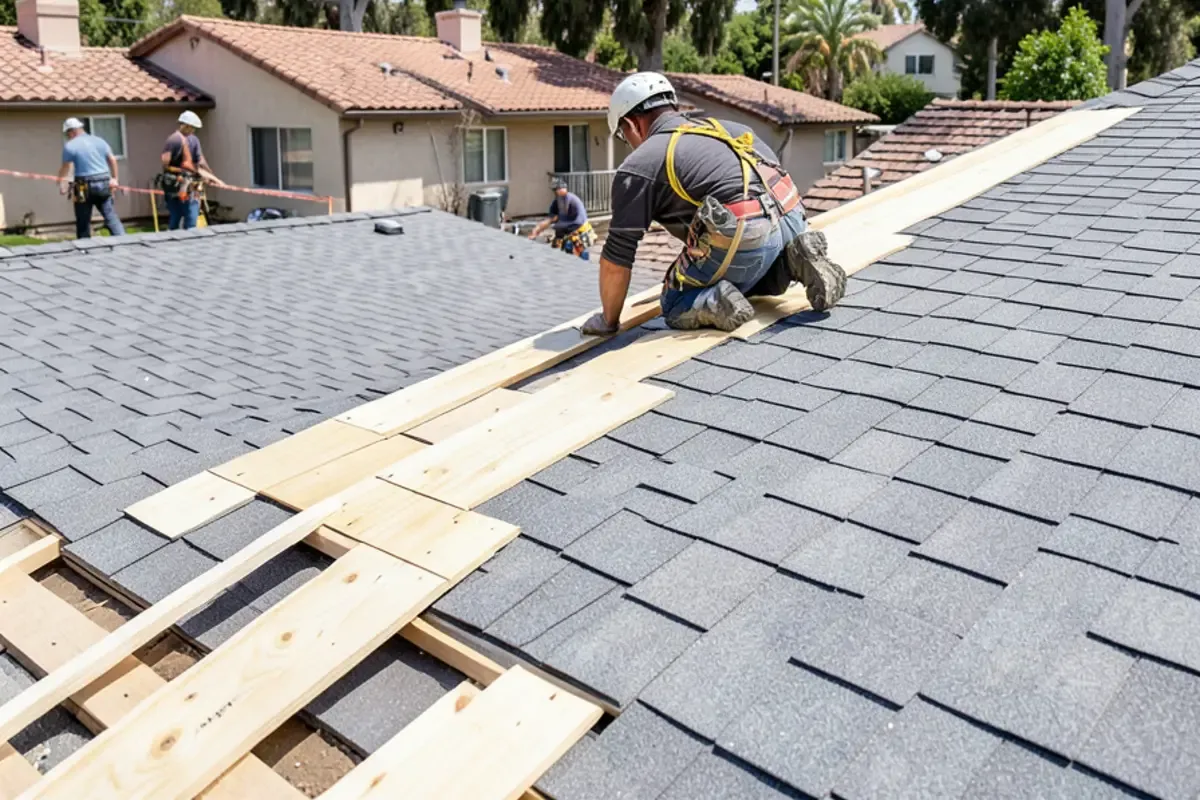
This is the hardest call homeowners face on day one. Waiting lets the adjuster see the tree in place, but every hour the roof stays open risks more water damage, and policies generally expect you to prevent further loss. Our usual advice is to ask the insurer on the first call whether they can inspect quickly, then photograph and video everything thoroughly and proceed with removal and a tarp if they cannot come before rain is forecast. Keep the cut sections of trunk on the property until the adjuster has seen them, if space allows.
Which trees over your roof deserve a closer look?
Most strikes come from trees that showed warning signs first. Walk your lot once a year, ideally before the October start of wind season, and note any tree tall enough to reach the house.
- Dead or leafless limbs over the roof, which break first in wind.
- A new lean, or soil cracking and heaving on one side of the base after rain.
- Mushrooms, oozing or hollow sound near the trunk base, all signs of internal decay.
- Large limbs joined in a tight V with bark pinched between them, a weak union that tends to split.
- Branches resting on or rubbing the roof, which grind shingles and give roof rats a bridge to the attic (see animal damage roof repair).
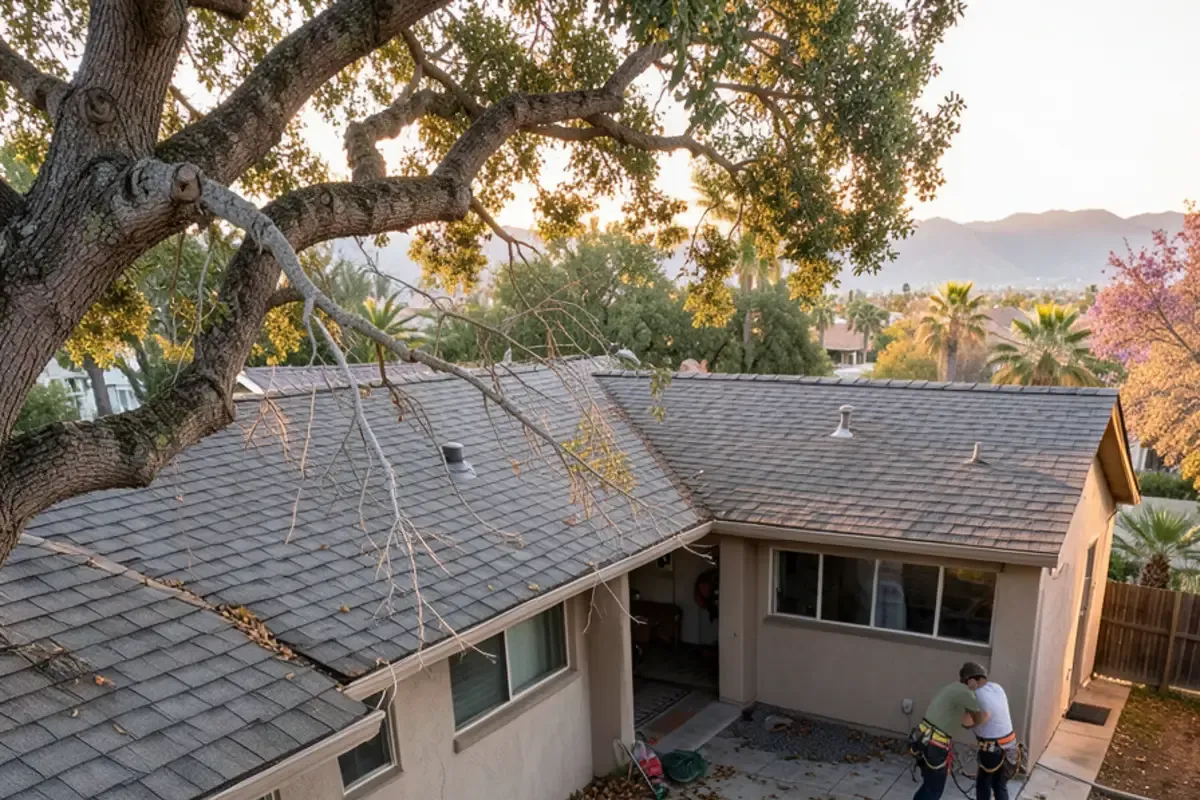
Trimming limbs back so they clear the roof by several feet keeps leaves out of valleys and stops abrasion, and it is far cheaper than a crane removal. If a tree belongs to a neighbor or sits in the city parkway, raise it in writing with them before the next storm.
Get the weight off, the hole covered, and the framing checked
The sequence keeps a bad day from getting worse: safety, photos, tree removal, tarp, then a structural repair with a permit when needed. If a tree or limb is on your roof now, call (725) 745-8803 and we will coordinate with your tree crew. When crews are free, the visit is same-day or next-day; otherwise you get a firm time on the phone.
Questions readers ask
My neighbor's tree fell on my roof. Whose insurance pays?
Usually your own homeowners policy handles damage to your house, even when the tree grew next door. Your insurer may pursue the neighbor if the tree was obviously dead or dangerous and they were told about it. Report the claim to your carrier first and keep photos of the tree before removal.
Can the roof be repaired, or does it need replacing?
Most tree strikes are repaired as a section: new framing where needed, new decking, and matching shingles or tiles blended into the existing roof. A full replacement makes sense when the roof was near the end of its life anyway or when matching material is no longer available. We price both when that question applies.
How long does fallen tree roof repair take?
The tarp goes on the day the tree comes off. The permanent repair depends on the framing work, permit and inspection, and material matching. A small puncture with only decking damage can be fixed in a day, while broken rafters or trusses take longer because of permits and possible engineering.
Should I call an arborist or a tree service after a tree hits the house?
Call a licensed tree service for the removal itself, since it brings the rigging, crane access and crew. An arborist assesses tree health and is the right person to judge whether other trees on the lot are likely to fail. Many tree companies employ certified arborists, so one call can cover both. Check the license at cslb.ca.gov before work starts.
Sources
Written by Tylzen Spoke Roofing
A roofing contractor on Rosemead Blvd (CA-19) in Rosemead, working on shingle, tile, metal and flat roofs across the San Gabriel Valley. This guide reflects what our crews check on local roofs. Questions about your roof? Call (725) 745-8803.