
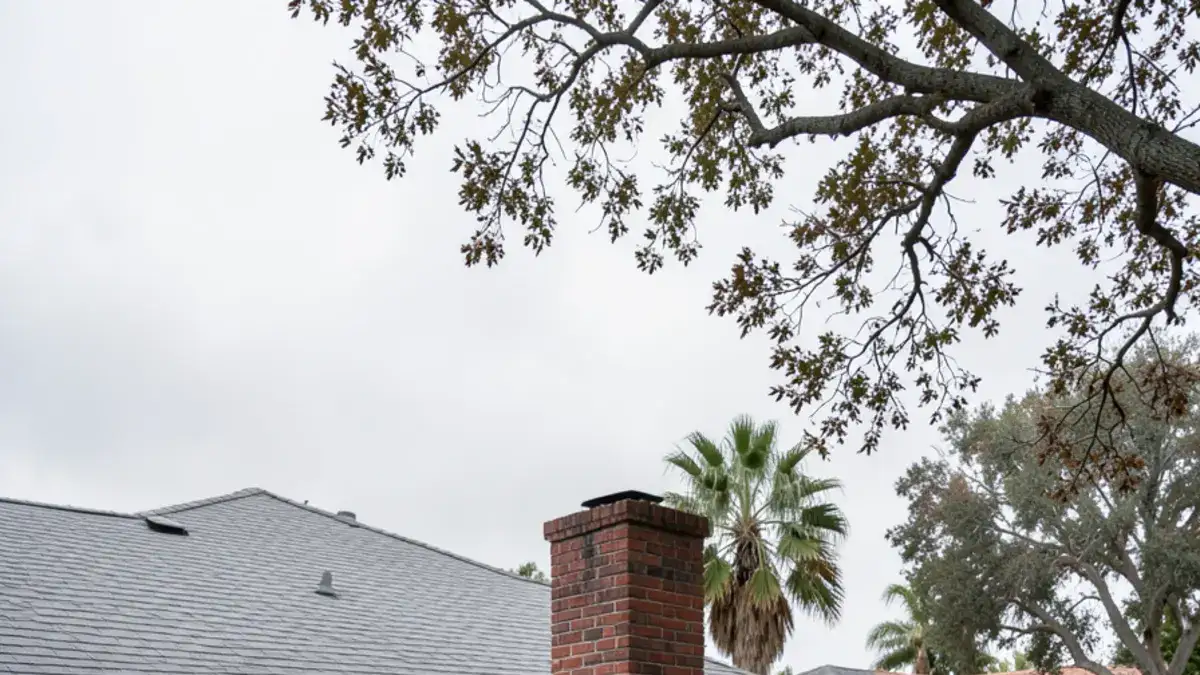
Chimney flashing repair in Rosemead fixes the most leak-prone joint on many older roofs: the seam between a brick chimney and the roof around it. Brick and roof move differently, mortar shrinks and cracks, and a lot of chimneys here were sealed with tar and mortar instead of proper metal. We rebuild the flashing in the correct layers so water runs over the joint instead of into it.
This work falls under our roof repair service in Rosemead, and it is common on the 1940s and 1950s houses that still have their original fireplaces.
Signs water is getting in around your chimney
- Stains on the ceiling or wall beside the fireplace, or on the mantel.
- Damp or rusty damper, or water in the firebox after rain.
- Wet, dark framing around the chimney when you look into the attic.
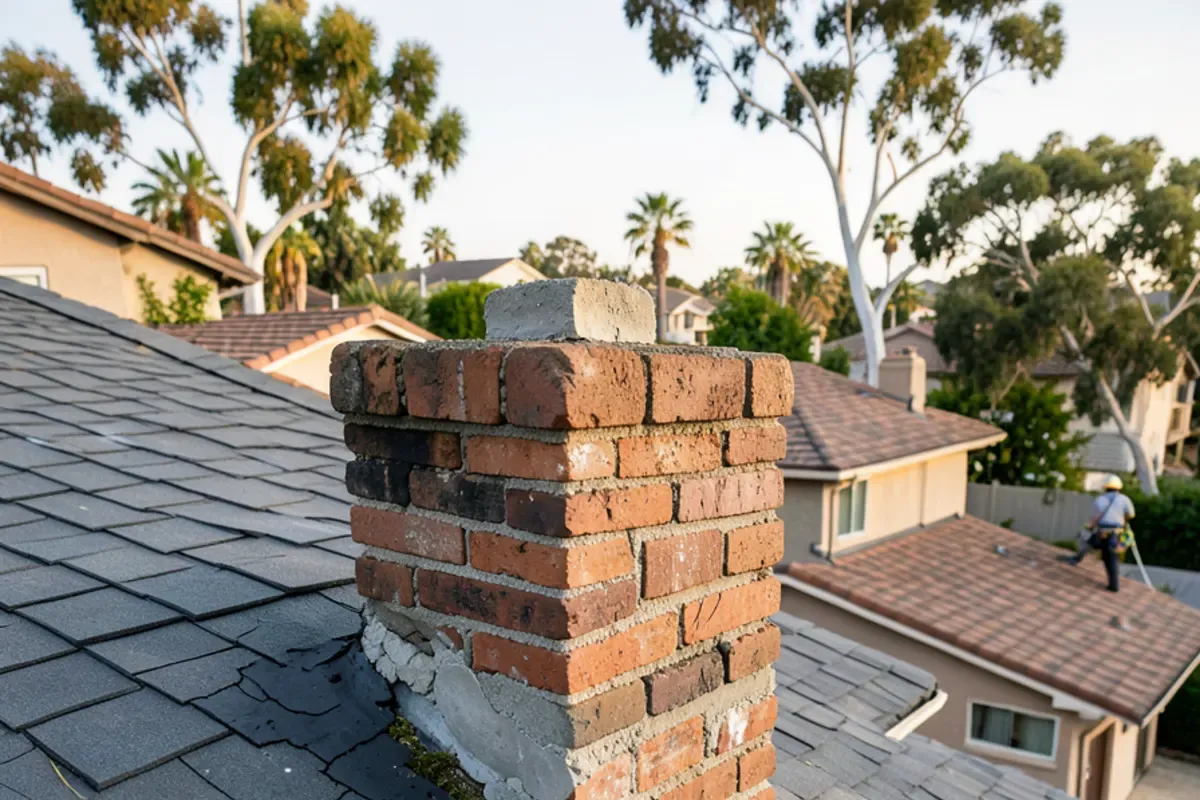
- Cracked mortar or a thick, crumbling black seal where brick meets roofing.
- Shingles or tiles that stay wet on the upslope side long after a storm.
- White crusty deposits on the brick, a sign water is moving through it.
How a chimney should be flashed
Good chimney flashing is a set of overlapping parts, each shedding water onto the next. When one is missing, the rest cannot make up for it.
- Apron flashing across the downslope face, laid over the roofing below.
- Step flashing up each side, one piece woven under every course of shingle or tile.
- A back pan or cricket on the upslope side, so water is split around the chimney instead of pooling behind it.
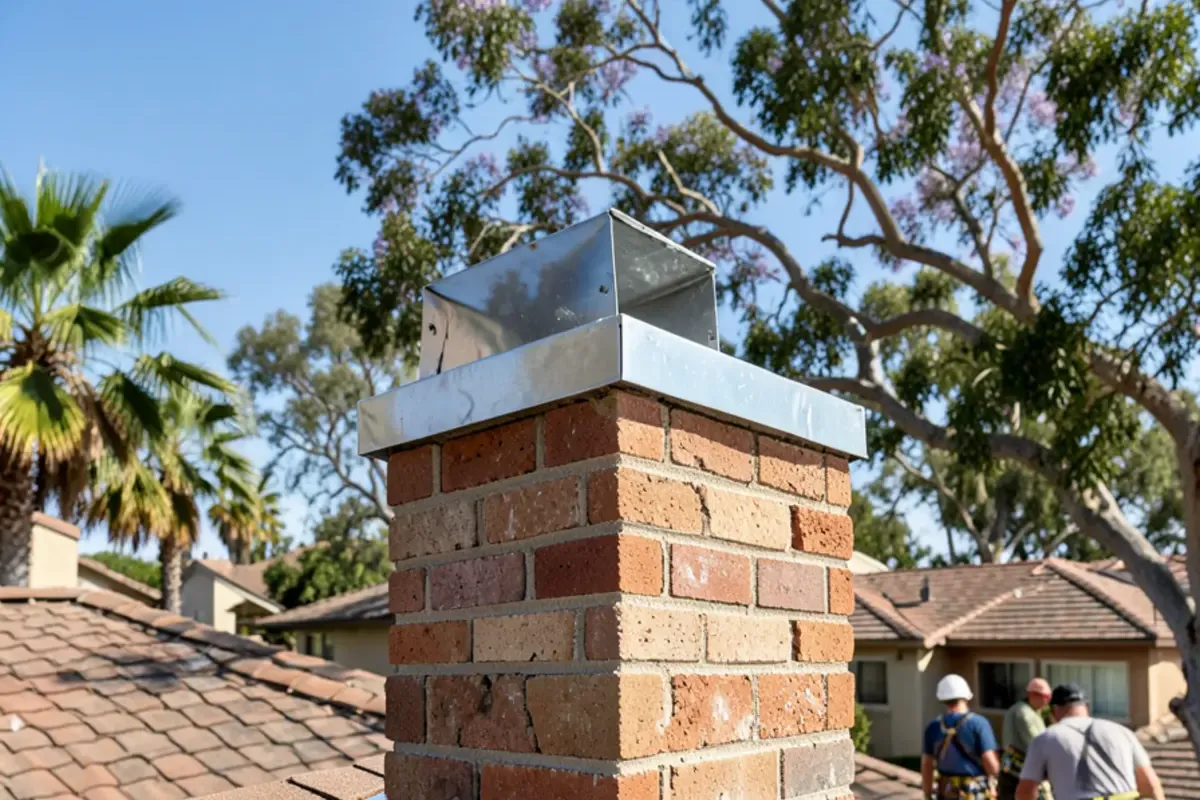
- Counter flashing set into the mortar joints and folded down over all of the above.
Counter flashing is the piece most often done wrong. It should be let into a raked-out mortar joint, stepping up the sides with the slope, and sealed there. When it is simply glued to the face of the brick, the bond lets go and water runs behind it.
What goes wrong at older Rosemead chimneys
Many local chimneys are older than the roof around them by several reroofs. Each reroof crew either replaced the flashing or worked around it, and many simply troweled roof cement over the old joint. That seal looks fine for a year and then cracks.
Movement is the other cause. Brick chimneys sit on their own foundation and settle differently from the house, and earthquakes test them hard. The M5.9 Whittier Narrows earthquake of 1987 struck close by, and some chimneys in the area still carry cracks or lean slightly. Any gap between brick and roof opens a path for winter rain.
Width matters too. A wide chimney without a cricket acts like a dam. Leaves collect behind it, water stands, and it finds every flaw in the back flashing.
Is it the flashing, the crown or the brick?
Water at a chimney can come from three places, and we check all of them before quoting.
- Flashing: we lift roofing beside the chimney to see whether step flashing exists and how it laps.
- Crown and cap: the concrete or mortar top of the chimney cracks, and an uncapped flue lets rain straight down.
- Brick and mortar: open joints and spalled brick soak up water that then runs down inside the chimney.
- Attic: we follow stains on the framing to see which face of the chimney the water comes from.
- Water test: on a dry day, we hose the roof joint first, then the brick, to separate the two.
We repair the roof side. When the crown or brick is the problem, we photograph it and tell you so a mason can take care of the masonry.
Chimney flashing repair in Rosemead, done in layers
Full flashing rebuild
We remove the roofing around the chimney, cut out old metal and cement, and install new underlayment turned up the brick. Then come apron, step flashing and back pan, followed by counter flashing set into freshly ground mortar joints. The roof covering goes back around it.
Chimney cricket installation
A cricket is a small peaked frame built behind the chimney and covered with metal or roofing. Residential code calls for one on chimneys more than 30 inches wide that do not sit on the ridge, and we recommend it on narrower ones where debris collects.
The cricket adds a joint of its own where it meets the brick, so that line gets full counter flashing too. Wherever counter flashing folds over step flashing, we keep an overlap of about 2 inches so wind cannot push water up and behind it.
Roof patch after chimney removal
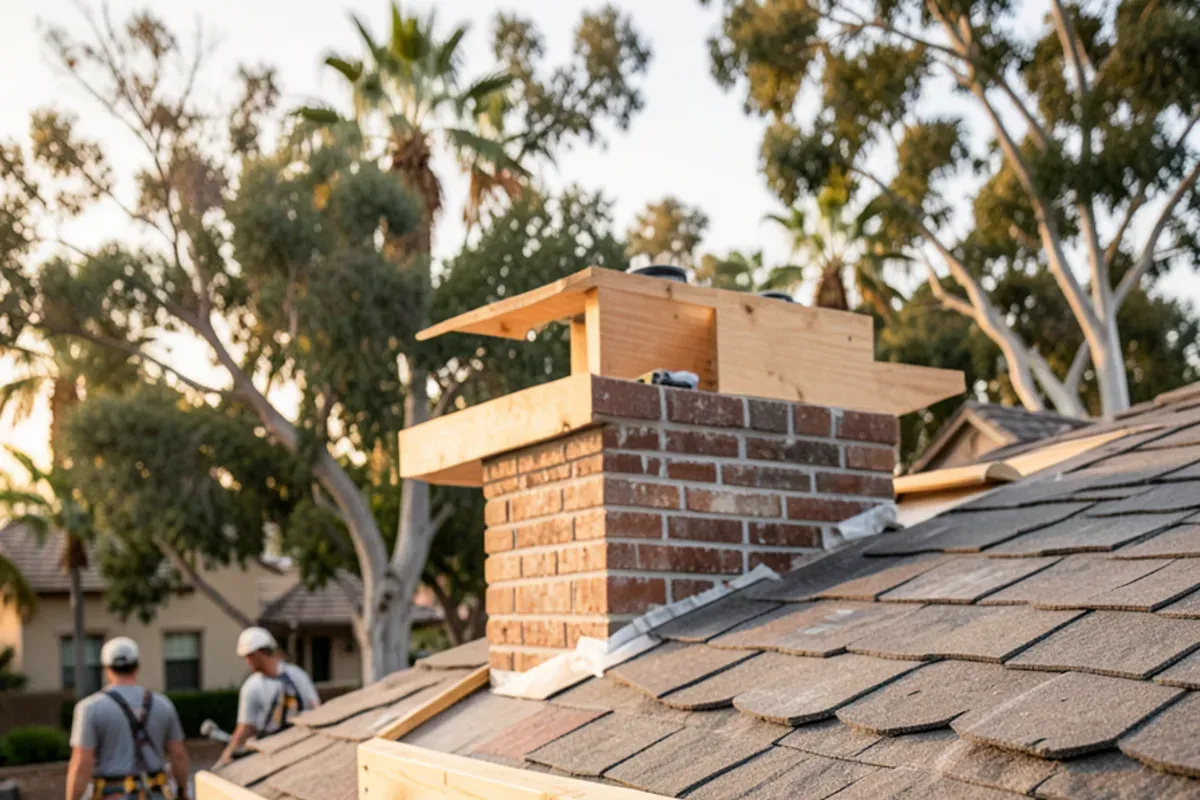
When a cracked chimney is taken down below the roof, the hole needs framing between the rafters, new decking, underlayment and matching roofing. Done properly, the patch is hard to see. If the removal left soft or charred wood, our roof deck and dry rot repair work covers it.
Need chimney flashing repair help this week?
Tell us what you are seeing. We schedule same-day or next-day visits when crews are free and send photos with a written quote.
- 4.9 from 48 Google reviews
- Based on Rosemead Blvd
- Photos and a written quote before work
How long does a chimney flashing job take?
Most rebuilds on a shingle roof take one day. Tile roofs, wide chimneys that need a cricket, and roof patches after removal can run to a second day. If rain is coming, we cover the opening with a tarp overnight.
- We photograph the chimney, the attic and every face of the joint.
- You get a written quote that lists flashing, cricket and any decking separately.
- On the day, landscaping and the fireplace area are protected from debris.
- Old metal and cement come off, new layers go on, and mortar dust is cleaned up.
- You receive photos of the new metal before the roofing covers it.
What affects the cost of chimney flashing work
For planning, Manta's 2023 calculator places a typical LA County roof repair at $1,185-$1,625 before permits; it is not a quote. A narrow chimney on shingle with sound mortar sits near the low end of chimney work. A wide stack on clay tile that needs a framed cricket and rotted sheathing replaced costs more, and each of those appears as its own line.
- Chimney size and whether it needs a cricket.
- Roof covering, since tile around a chimney is slow to lift and reset.
- Condition of the mortar joints where counter flashing is set.
- Rotted sheathing or framing around the chimney base.
- Whether the chimney sits mid-slope, at the eave or on the ridge.
Permits, masonry trades and licensing at the chimney
Rebuilding flashing around a standing chimney is usually repair work without a permit. Taking a damaged chimney down and framing the opening is different: it changes the structure, so check with Rosemead Building and Safety, or the city or county office that covers your address, before demolition starts. Where a permit applies, we pull it for the roof patch and book the inspection.
Roof-side work over $1,000 in labor and materials needs a CSLB-licensed contractor in the C-39 Roofing class, and masonry carries its own classification. At cslb.ca.gov you can confirm a roofer's or mason's license and workers' comp record.
Why homeowners with older chimneys call Tylzen Spoke
- Reviewers mention plain explanations of what failed and no push toward work that is not needed.
- A photo record of the old joint and the new layers, plus an itemized written quote.
- Same-day or next-day visits when our crews are free, from our base on Rosemead Blvd.
- We document damage for insurance and can meet the adjuster, though claim negotiation is left to licensed public adjusters.
Manufacturer coverage on the flashing metal and roofing depends on the product line used. Workmanship terms appear in the contract itself; request a written copy of each and check whether a buyer of the house would inherit them.
We work on chimneys in South Pasadena, Sierra Madre and Alhambra, as well as Rosemead. A crumbling peak line near the chimney is a job for ridge cap repair.
What customers say on Google
4.9★ from 48 Google reviews (checked Nov 2026)
“We had a very good experience with Tylzen Spoke Roofing for our roof work. At first, I was careful because they came to the door offering roofing services, and it almost seemed too simple, but they proved to be trustworthy and professional. …”
“Our flat garage roof had a leak, and since the main roof was already aging, we decided to handle the full roofing project at the same time and upgrade from asphalt shingles to a metal roofing system. …”
“They exceeded my expectations and fixed my roof leak the same day. William and Brandon were professional, efficient, skilled, knowledgeable, respectful, and easy to work with. They found and corrected a roofing issue that was left behind after a previous roof installation, which had been causing the leak. …”
Where we handle chimney flashing repair
- Rosemead
1940s and 1950s homes with original brick fireplaces, often sealed with roof cement through several reroofs.
- South Pasadena
Craftsman-era houses with tall brick chimneys where counter flashing must be cut into old, soft mortar joints.
- Sierra Madre
Foothill bungalows with wide masonry chimneys that collect oak leaves behind them and need crickets.
- Alhambra
Older homes whose chimneys settled apart from the roof over decades, opening gaps at the side flashing.
- Pasadena
Craftsman bungalows with river-rock and brick chimneys where step flashing was left in place through reroofs.
- San Gabriel
Spanish Revival homes with stucco-clad chimneys on clay tile roofs, slow to lift and reflash.
- Monrovia
Foothill Craftsman and ranch homes where cracked chimneys are taken down and the roof opening patched.
- Temple City
Ranch homes with mid-slope brick chimneys that dam water and debris on the uphill side.
- San Marino
Large period homes with several chimneys, where layered flashing and crickets protect costly interiors below.
More places we handle chimney flashing repair
Chimney Flashing Repair questions
Why does water get in where the chimney meets the roof?
Because brick and roof are separate structures that move apart over time, and the joint between them depends entirely on flashing. If the flashing is missing, rusted or replaced by roof cement, water runs straight into the gap. Wide chimneys without a cricket also trap water on the uphill side, where it eventually finds a weak spot.
Can you patch the roof after a damaged chimney is taken down?
Yes. Once the chimney is removed below the roofline, we frame the opening between rafters, install new decking and underlayment, and match the roofing around it. On shingle roofs we weave new shingles into the old courses. On tile, we use salvaged or matched tiles so the patch blends in.
What is a chimney cricket, and does my roof need one?
A cricket is a small ridge built behind the chimney that splits water around it. Residential code calls for one when a chimney is more than 30 inches wide and does not sit on the ridge. Even narrower chimneys benefit if leaves pile up behind them. We tell you after measuring whether yours needs one.
Do you fix the chimney crown and brick too?
We handle everything on the roof side: flashing, crickets, counter flashing joints and the roofing around the base. Crown cracks, spalled brick and rebuilding the stack are masonry work. When we find those, we photograph them and let you know so you can bring in a mason before or after our repair.
Can chimney flashing be repaired on a tile roof?
Yes, though it takes more time. We lift the tiles around the chimney, install new underlayment, step flashing and a pan or cricket, and form the apron to fit the tile profile. Then the tiles are relaid, with broken ones replaced. Tile chimney jobs often need a second day.
Should I waterproof my chimney brick?
If water is soaking through the brick itself, a breathable masonry water repellent can help, but only after cracked joints are repointed. Avoid paint or non-breathable sealers, which trap moisture inside the brick. A mason can advise on the right product; our part is making sure the flashing is sound first.