
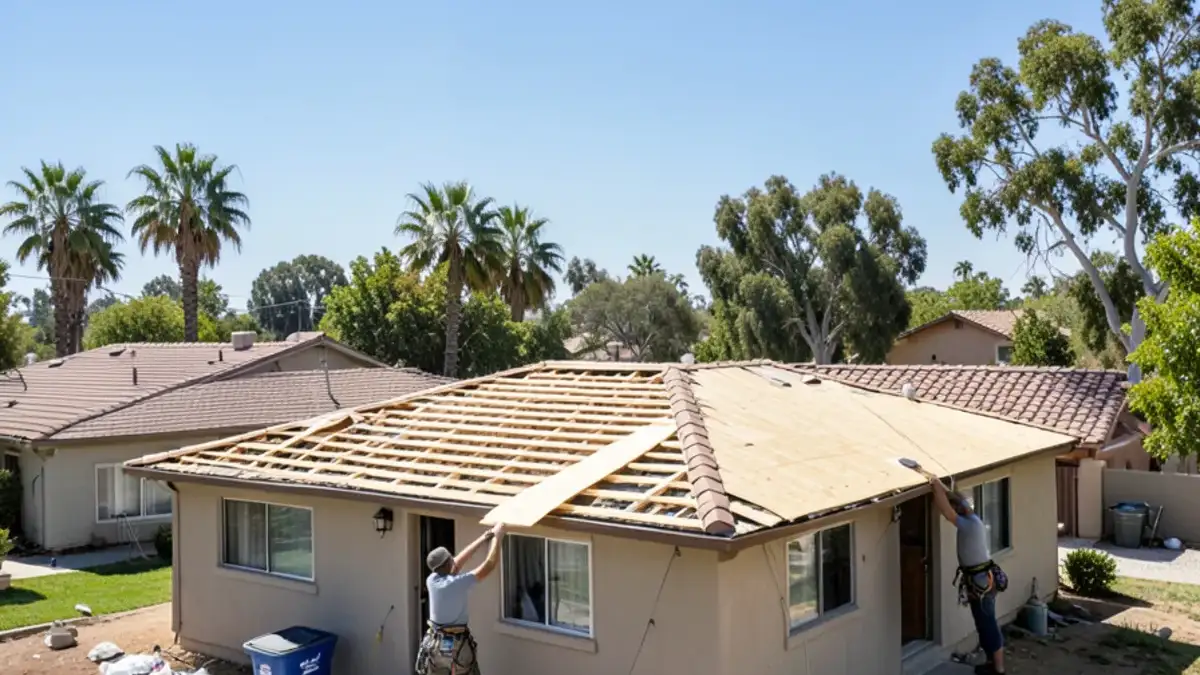
Roof dry rot repair in Rosemead usually starts with a surprise: a soft spot underfoot, a sagging eave, or a section of decking that crumbles when the old shingles come off. Rot in roof wood comes from slow, repeated wetting, and on houses that have been reroofed two or three times it can hide for years. We remove the damaged wood, replace it with matching material and make sure the cause of the moisture is fixed too.
Rot repair sits within our Rosemead roof repair work and usually comes up alongside leak, flashing and reroof projects.
Signs of rotted roof decking and eaves
- Spots that feel spongy or bounce when walked on.
- Dips between rafters visible from the street in low-angle light.
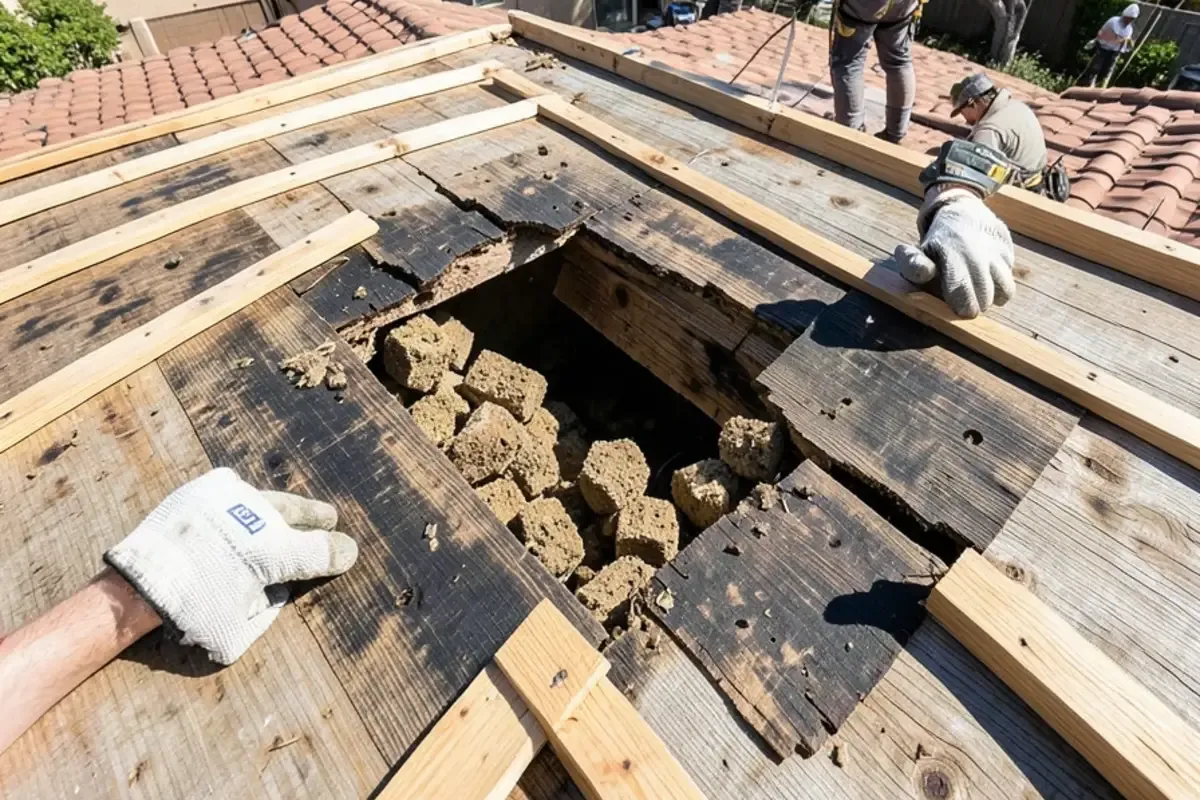
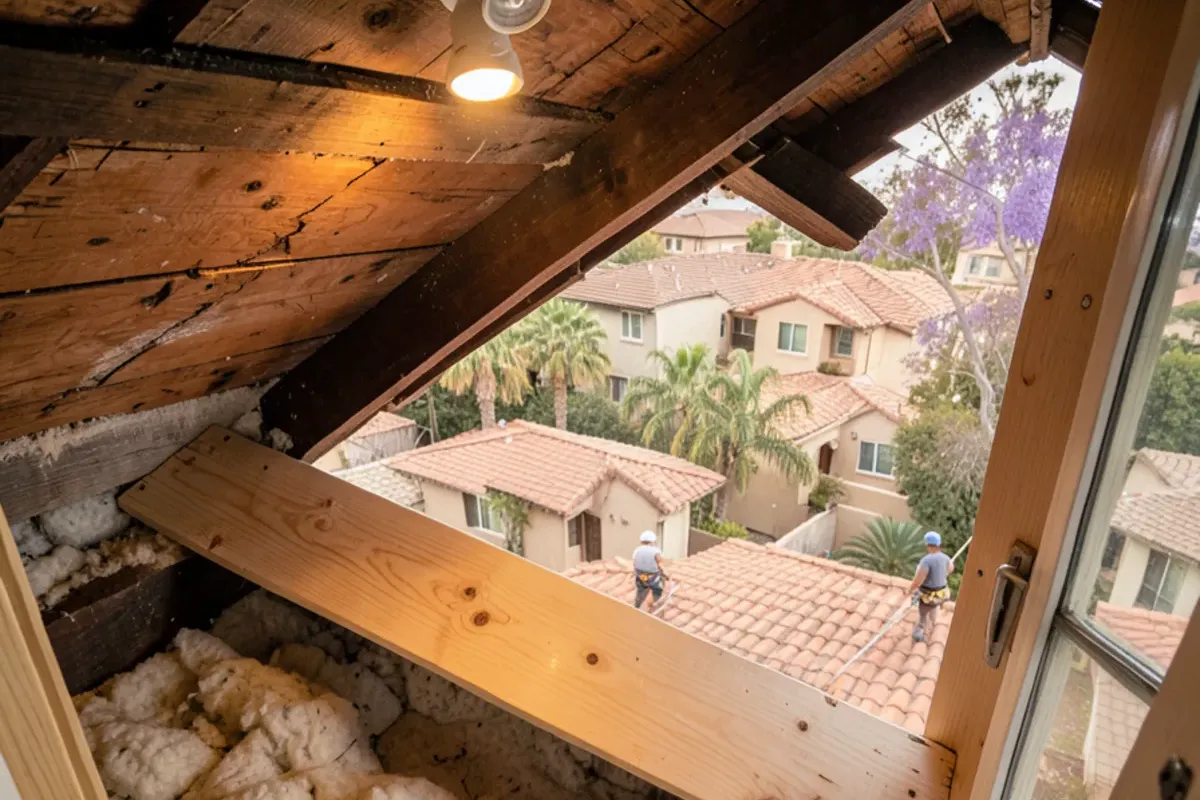
- Dark, crumbling or stained sheathing seen from the attic.
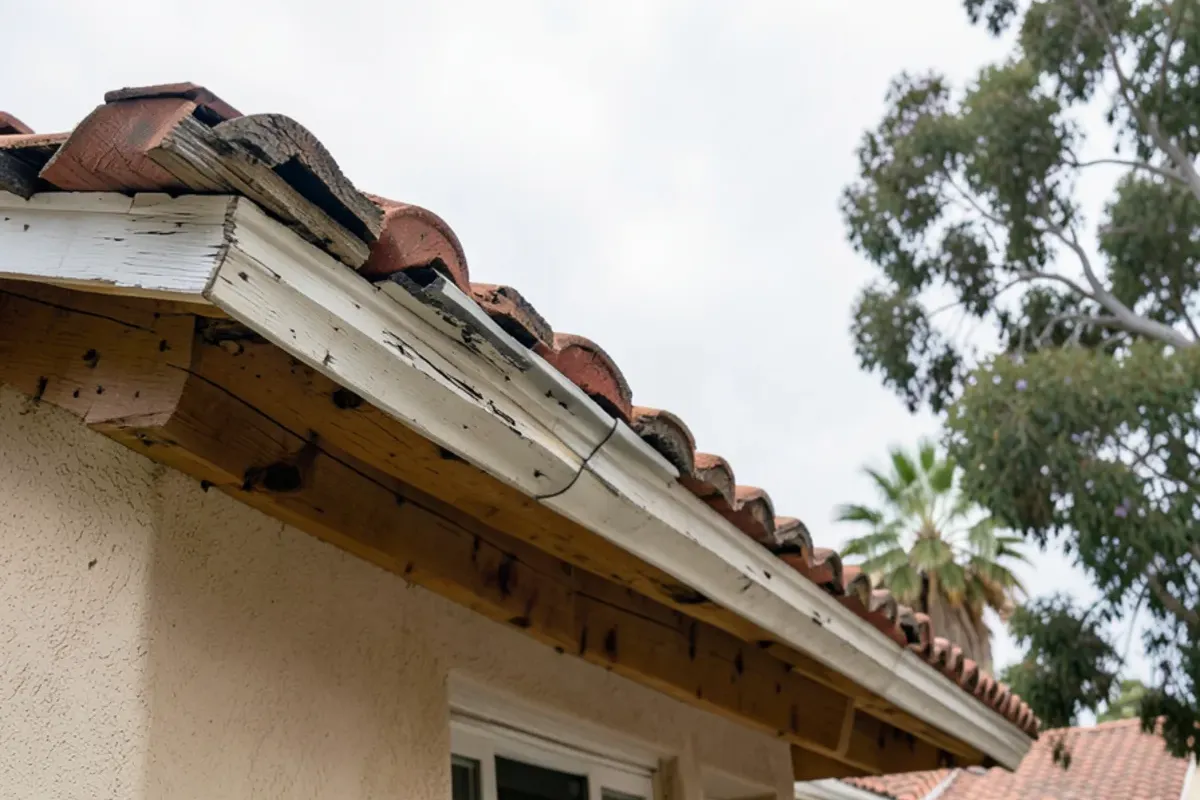
- Exposed rafter tails at the eaves that are split, soft or missing their ends.
- Eave boards and fascia with peeling paint, gaps or fungal growth.
- Gutters pulling away because the wood behind them no longer holds screws.
Why roof wood rots on older San Gabriel Valley homes
The name is misleading. Dry rot is fungal decay, and the fungus needs moisture to grow. A leaking pipe boot or flashing that drips a little each storm keeps the same patch of sheathing damp through the November to March rainy season. It dries over summer, then gets wet again the next winter, and the fibers break down a little more each cycle.
Housing age adds to it. With Rosemead's median build year at 1959, many roofs sit on original board sheathing that has seen several reroofs. Some houses still have spaced boards left from an original wood shake roof. Two layers of shingle hide the deck's condition and add weight, and the open eaves with exposed rafter tails on many ranch homes take direct rain and sun where gutters overflow.
Poor attic ventilation also plays a role. Warm, moist air from the house condenses on the underside of the deck in cool weather, and over time that is enough to soften the sheathing near the ridge. Bathroom fans ducted into the attic instead of out through the roof add the same moisture, and we often find the softest sheathing right above one.
Finding hidden rot before the roof comes off
No one can see every board until the roofing is off, but a careful inspection narrows it down.
- From the attic, we look for stains, dark patches, fungal growth and nails rusted through.
- We probe suspect areas with an awl from below; sound wood resists, decayed wood gives.
- On the roof, we walk the slopes to feel for soft or deflecting spots.
- At the eaves, we check rafter tails, eave boards and fascia from a ladder.
- Everything is photographed and marked on a simple sketch of the roof.
Your quote then lists the deck we know needs replacing as a fixed line, and a per-sheet or per-foot price for anything else found once the roof is opened. That way there is no open-ended surprise later.
Roof sheathing replacement and structural repair methods
Sheathing patches and full deck replacement
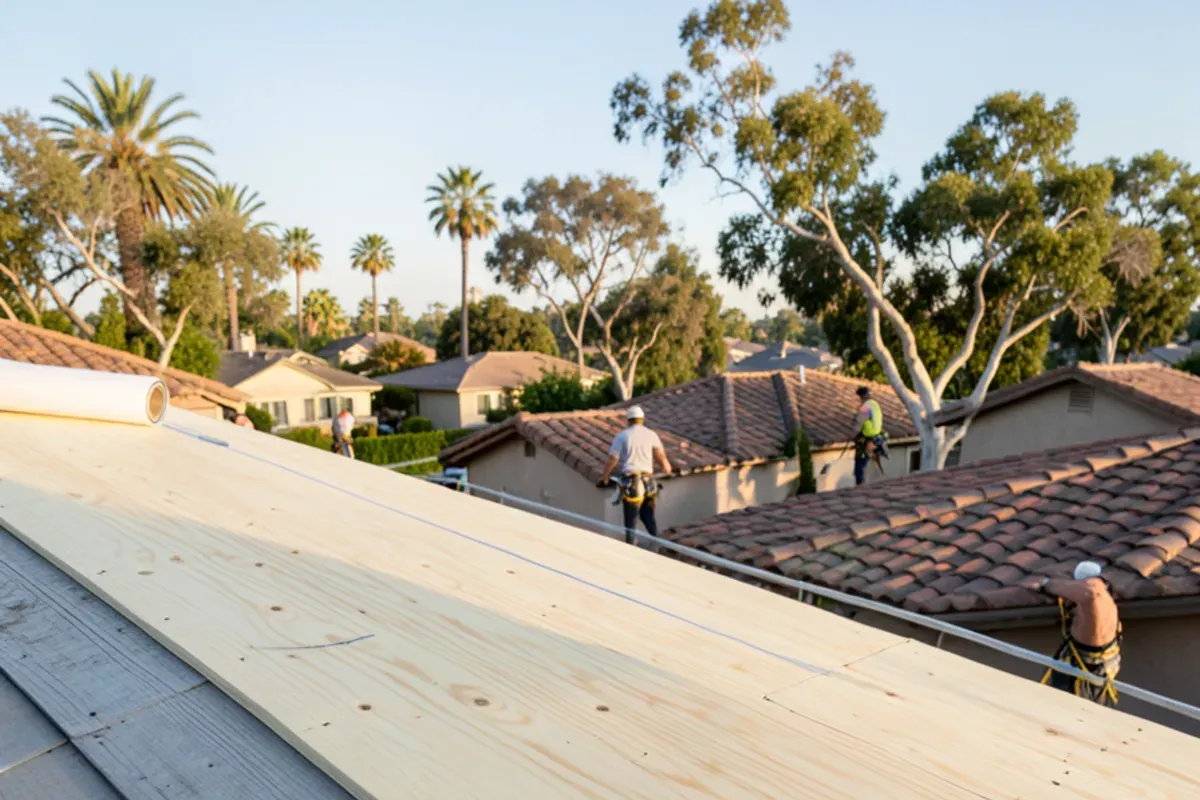
Rotted sheathing is cut back to the nearest rafters and replaced with plywood or OSB rated for roof decks, matched in thickness so the new section sits flush. Where a full slope is bad, we replace it in full. Spaced board decks are covered with new sheathing before modern roofing goes on.
Rafter tails and eave boards
Exposed rafter tails are part of the look on many ranch and Craftsman houses, so we cut back the decayed end and splice on a new tail shaped to match, or sister a new piece alongside. Eave boards and fascia are replaced in the same pass so gutters have solid wood to mount to.
Sagging rooflines
A sag can come from rot at a bearing point, undersized rafters, heavy layers, or ceiling joists and ties removed in an old remodel. Many sags can be corrected by sistering rafters and adding purlins, struts or collar ties. If the framing problem is larger, we recommend a structural engineer before any roofing work.
Is it dry rot, termites or both?
Drywood termites are common in Southern California, and their damage can look like rot from a distance. Termite galleries follow the grain and leave small pellets; fungal decay leaves wood soft, cracked into cubes or stringy. Often the two appear together because damp wood attracts insects.
We replace damaged roof wood whatever the cause. We do not treat insects. Active termites are a job for a pest control company holding a state license, and when we find them we say so, so treatment can be arranged before or after the repair.
Need roof deck & dry rot repair help this week?
Tell us what you are seeing. We schedule same-day or next-day visits when crews are free and send photos with a written quote.
- 4.9 from 48 Google reviews
- Based on Rosemead Blvd
- Photos and a written quote before work
What happens during deck and rafter repair
- We pull the permit when the scope requires one, which is common when decking is replaced.
- Roofing is removed over the damaged area and the wood exposed for you to see.
- Decayed wood is cut out, framing is repaired, and new sheathing is nailed to the rafters.
- The source of the moisture, such as a boot, flashing or vent, is repaired before closing up.
- Underlayment and roofing go back on, and any open area is tarped overnight if needed.
- Where the inspector wants to see the deck before it is covered, we schedule that visit.
A small patch with a few sheets is usually a one-day job. Rafter tail and eave work along a full side of the house, or sag correction, can take several days.
What does roof dry rot repair cost in Rosemead?
Price follows the amount of wood replaced and how much roofing must come off to reach it. Quotes are written per sheet of decking and per foot of rafter tail or fascia, so the cost scales with what we actually find.
For a planning reference only, Manta's 2023 calculator puts LA County roof repairs at $1,185-$1,625, permits excluded. A few sheets under one leak usually fall inside a range like that; a sag correction or a full side of rafter tails does not. Real numbers depend on size, pitch, layers, deck condition and material.
- Number of sheets and whether they are scattered or in one area.
- Rafter tails, eave boards or fascia that need replacing.
- Framing work to correct a sag.
- Roof material over the damage, since tile takes longer to remove and relay.
- Permit and inspection lines, listed separately.
Who may do deck, framing and termite work in California
Roof sheathing and rafter repairs are roofing work, so jobs over $1,000 in labor and materials need a CSLB-licensed contractor, with C-39 the roofing classification. Because deck replacement usually needs a permit, it also needs a licensed contractor whatever the size. Check any roofer at cslb.ca.gov, including workers' comp status.
Termite treatment and wood-destroying-pest reports come from pest control companies licensed by the state Structural Pest Control Board, which is a separate trade. When a sag points to a framing problem beyond sistering, a structural engineer should design the fix before roofing starts.
Why homeowners call Tylzen Spoke when the deck is soft
- Before any work starts, you see photographs of the damaged wood and a quote that prices deck work line by line.
- Reviewers mention clear explanations and crews that protect yards and driveways.
- From our shop on Rosemead Blvd we can usually be on site same-day or next-day when crews are free.
- We handle the permit and inspection whenever the scope calls for one.
Sheathing and roofing products come with manufacturer coverage tied to their product line, and workmanship terms are part of your signed contract. Get a written copy of both, and confirm whether they transfer to a future buyer.
We repair decks and eaves in South San Gabriel, East Los Angeles, Pico Rivera and Whittier. Rot near the eaves often starts where animals have opened gaps, covered under animal damage roof repair, or under a cracked boot, covered under vent and pipe boot repair. For a full strip, see roof tear-off.
What customers say on Google
4.9★ from 48 Google reviews (checked Nov 2026)
“A recent strong wind loosened a shingle on my roof in Rosemead. It took just one call, and Tanner came out the very next day to help. While we talked, I mentioned how thankful I still am for the excellent roofing work the crew did years ago, which has continued to hold up very well. …”
“i had a bad roof leak that ended up causing a ceiling leak inside the house, but the whole experience turned out great with tylzen spoke roofing. grant called me back quickly after i left a message and came out the very next day to inspect the roofing issue. …”
“I contacted Tylzen Spoke Roofing several times to help with my roof after some storm damage caused us to lose a few tiles. William came out and gave me a clear and fair estimate. I provided the replacement tiles, and the crew handled the repairs quickly, making sure everything was secure and looked great. …”
Where we handle roof deck & dry rot repair
- Rosemead
Homes with a 1959 median build year, many on original board sheathing hidden under two shingle layers.
- South San Gabriel
Unincorporated post-war homes, permitted through LA County, where open eaves and exposed rafter tails rot at the ends.
- East Los Angeles
Older stucco homes and bungalows with decades of reroofs over spaced boards that once carried wood shakes.
- Pico Rivera
Post-war tract roofs where slow boot and flashing leaks have softened the deck beneath layered shingles.
- Whittier
Older homes on hillside and flat streets where sags and rotted eaves show up during tear-off.
- El Monte
Small tract homes with overflowing gutters that keep fascia, eave boards and rafter tails wet each winter.
- Alhambra
Older homes with past remodels and slow leaks, where altered framing shows up as a dip in the roofline.
- Montebello
Hillside and flatland homes whose original sheathing has weathered several reroofs and slow leaks.
- South Gate
Post-war stucco homes in the Gateway cities, where drywood termite damage and fungal decay often appear together.
More places we handle roof deck & dry rot repair
Roof Deck & Dry Rot Repair questions
How do you know how much rotted wood is under the roof before tear-off?
We get close but not exact. Attic inspection, probing from below, walking the slopes and checking the eaves reveal most rot. Your quote lists known damage as a fixed line and gives a unit price for any extra sheets found when the roofing comes off. You see photos of each extra piece before it is replaced.
Can a sagging roofline be fixed without a full rebuild?
Often, yes. Sistering new lumber to weak rafters, adding purlins and struts, or restoring ceiling ties can lift or stabilize a sag. The cause matters: rot at a bearing wall or a load path changed during a remodel needs to be addressed first. For larger structural problems we recommend a structural engineer before any repair.
Do you replace rafter tails and eave boards along with the sheathing?
Yes. Rotted rafter tails are cut back and spliced or sistered with new wood shaped to match the original profile, and eave boards and fascia are replaced in the same visit. Doing them together means gutters, soffit and roof edge all attach to solid wood.
Does replacing roof decking need a permit?
Usually, since it is structural work on the roof. Rosemead issues permits through its building division, and unincorporated areas such as South San Gabriel go through LA County Public Works. We pull the permit, list it as its own line on the quote and schedule the inspection.
Do you treat termites in roof wood?
No. We replace the damaged wood, but treating an infestation is the job of a licensed pest control company. If we see live activity or fresh pellets, we photograph it and tell you so treatment can happen before new wood goes in, which keeps the new lumber from being attacked.
Can new shingles go over spaced board sheathing?
Not directly. Spaced boards were made for wood shakes, which need airflow beneath them. Composition shingles need a solid deck, so we cover the boards with plywood or OSB sheathing first. This adds a line to the quote, but without it shingles sag and nails miss their hold.