
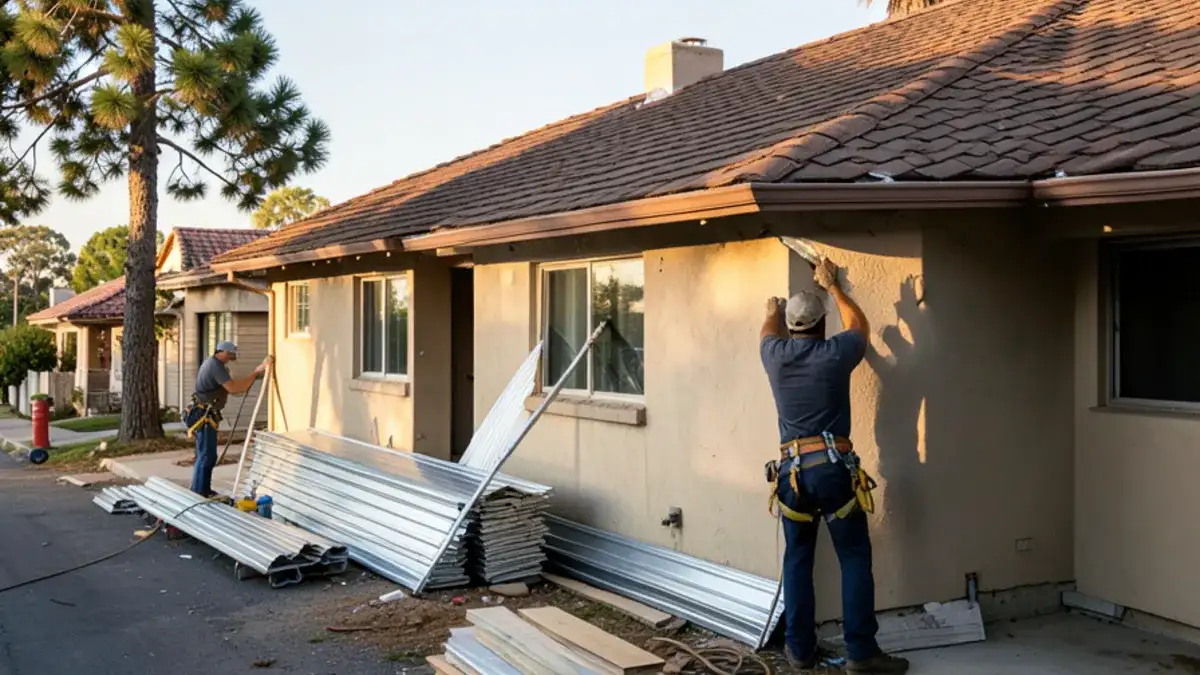
Roof flashing repair in Rosemead fixes the thin metal pieces that seal every joint on a roof: where a slope meets a wall, where two slopes meet in a valley, and along the eaves and rakes. On older homes these joints cause more leaks than the shingles or tiles do. We remove the failed metal, install new flashing lapped the right way, and relay the roof covering around it.
Flashing work is a core part of our Rosemead roof repair service, and it often turns up during other repairs because so many leaks start at a joint.
Where flashing fails on San Gabriel Valley homes
Most houses here are single-story stucco from the 1950s, but many have since gained a second-story addition, a family room or an enclosed patio. Every one of those additions created a new roof-to-wall joint, and many were flashed in a hurry.
- Stains along an exterior wall inside, or below a second-story junction.
- Bubbling paint or cracked stucco just above where a roof meets a wall.
- Rust streaks running down stucco from the end of a roof line.
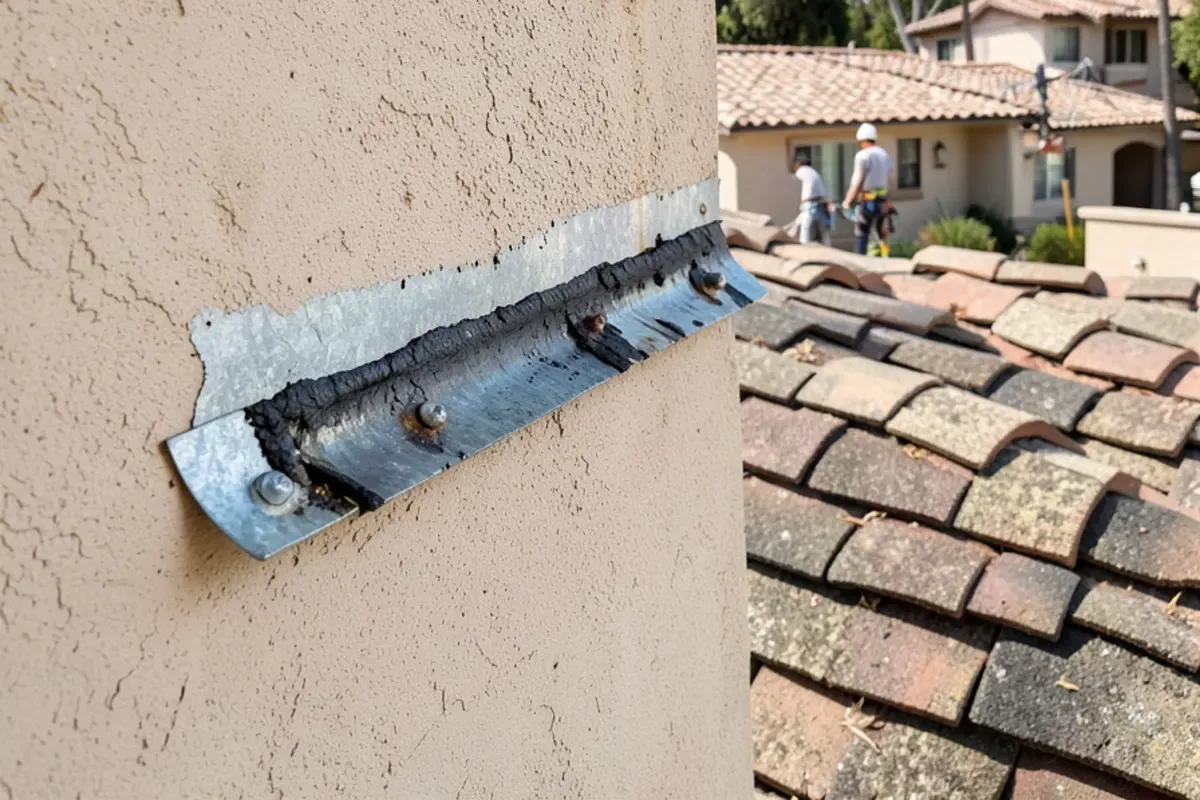
- Thick beads of caulk or roofing cement smeared along a joint.
- Leaks that appear only in wind-driven rain, not in a light drizzle.
- Peeling paint and soft wood on the fascia at the end of a valley.
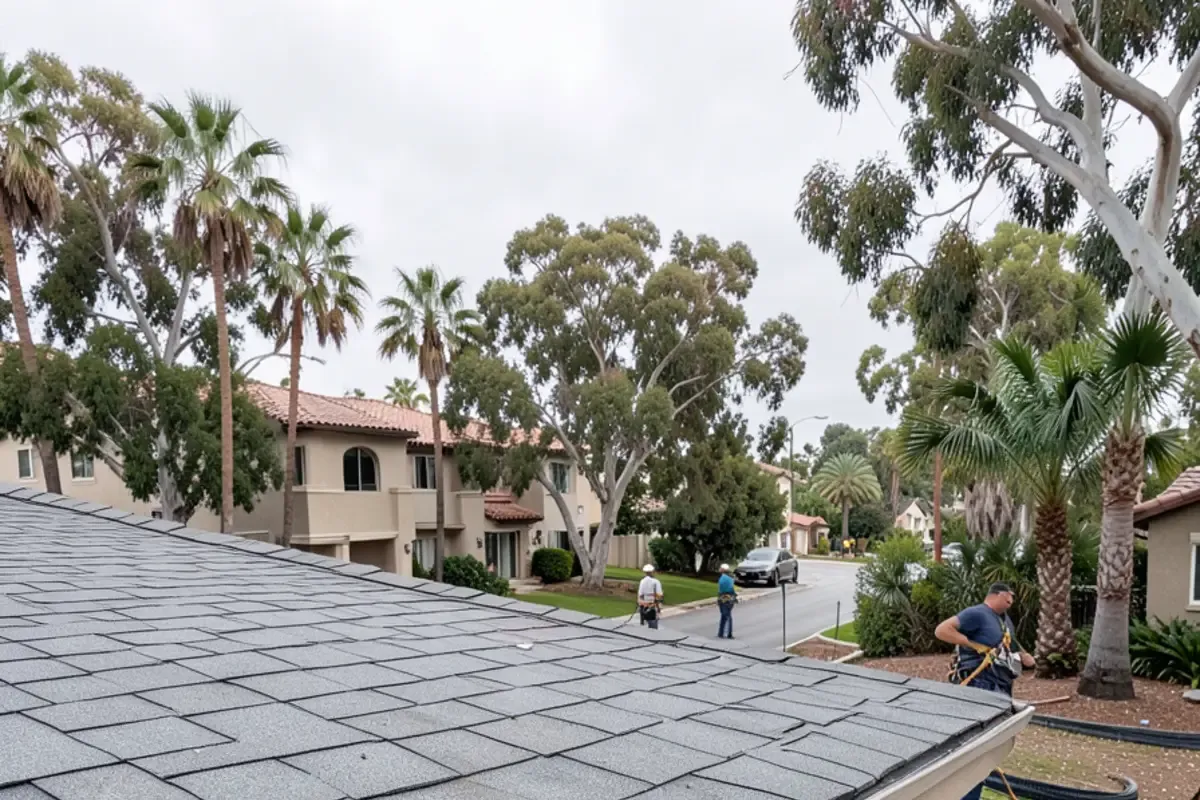
Types of roof flashing and what each one protects
| Flashing | Where it goes | Common problem we find |
|---|---|---|
| Step flashing | Along a sidewall, one L-shaped piece woven into each course | One long piece used instead, or pieces reused and rusted |
| Counter flashing | Laps down over the step flashing from the wall | Missing, or face-sealed to stucco with caulk |
| Kickout (diverter) | Bottom end of a roof-to-wall joint | Never installed, so water runs into the wall |
| Headwall or apron | Where the top of a slope meets a wall | Lifted by wind, sealant dried out |
| Valley metal | Inside corner where two slopes meet | Worn through under leaf piles, or nailed too close to center |
| Drip edge | Along eaves and rakes | Absent on many older roofs |
Skylights use their own flashing kits. If water shows up around a skylight well, see our skylight repair service, since the curb, the glazing seal and the flashing can each be the cause.
Why flashing gives out before the roof does
Flashing is usually sound metal undone by poor detail. The most frequent shortcut we find is face nailing: pieces nailed through the exposed surface and covered with sealant. That sealant cracks after a few hot summers, and every nail becomes a hole.
Reroofs cause the rest. When a roof is replaced, the old step flashing should come out with the shingles. On many homes it was left in place and the new roof laid around it, so the metal is far older than the shingles. Stucco cracks around the counter flashing, and wind-driven rain from winter storms pushes water sideways into the gaps.
How do we confirm a leak is a flashing leak?
We start with location. A stain along a wall or at an inside corner points to a joint. Next we check the attic for wet framing near the wall plate and the path the water took. On the roof, we lift the covering next to the joint to see the step flashing directly; caulk alone tells us little.
If that is not conclusive, we water-test the joint on a dry day, running the hose along the wall first and then the roof surface, so we can tell a flashing leak from a shingle or tile leak nearby.
We also rule out the wall above. If a stain centers under a second-story window rather than at the lower corner of the joint, the window flashing is the likelier source. Rusted step flashing several courses up can also send water down to the kickout area, so we check the whole run, not just the bottom piece.
Roof flashing repair in Rosemead: reseal, rebuild or replace
Reseal
Fine only when the metal is sound and correctly lapped, and just the exposed sealant at a counter flashing has dried. It is a maintenance step, not a repair for a joint that was built wrong.
Rebuild the joint
We remove the shingles or tiles along the wall, pull the old metal, add underlayment turned up the wall, and install new step flashing piece by piece with a kickout at the bottom. Then the roof covering goes back and counter flashing laps over the top.
Working with stucco walls
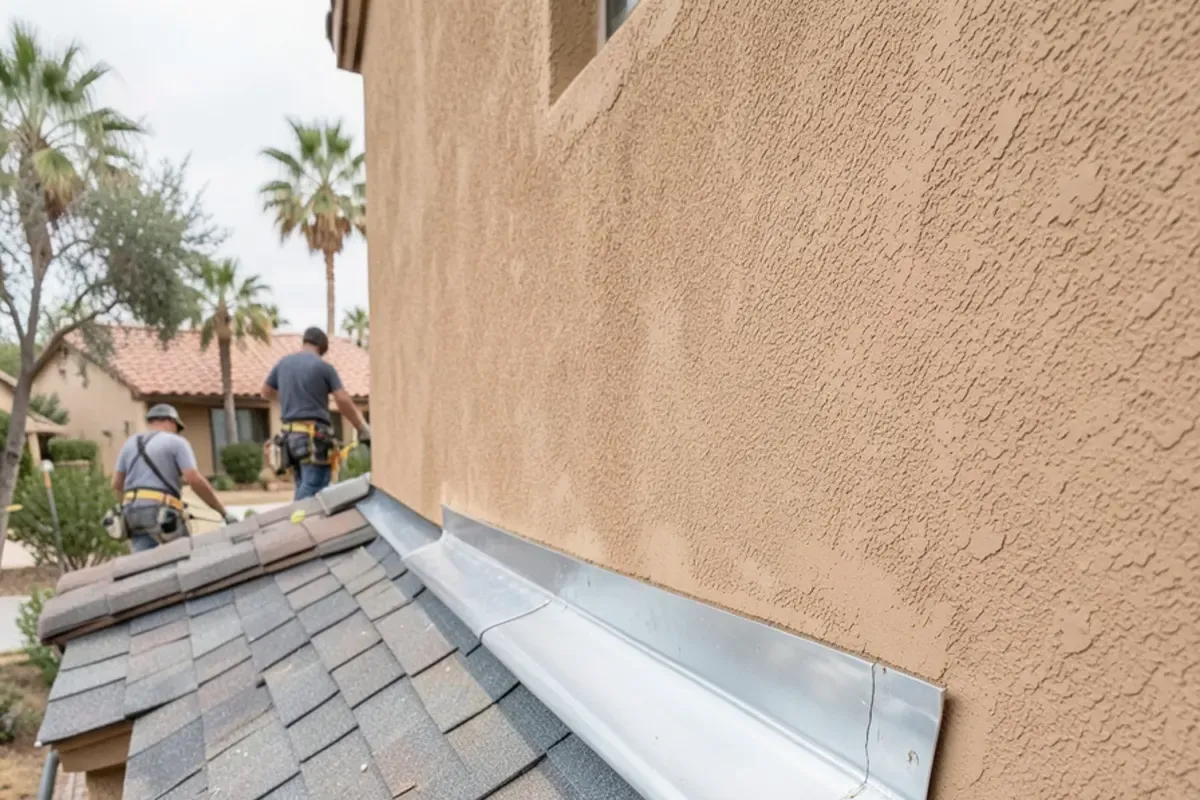
Counter flashing on a stucco house belongs behind the stucco or in a sawn slot called a reglet. We either cut a reglet and set new counter flashing into it, or remove a narrow band of stucco and patch it after the metal is in. Surface-mounted metal sealed to the wall is the fallback when neither is practical, and we tell you if that is the plan.
Valleys and drip edge
Worn valley metal is replaced by lifting the roofing on both sides. Drip edge can be added to an older eave by lifting the first course, sliding the metal under the underlayment at the eave and over it on the rakes.
Need roof flashing repair help this week?
Tell us what you are seeing. We schedule same-day or next-day visits when crews are free and send photos with a written quote.
- 4.9 from 48 Google reviews
- Based on Rosemead Blvd
- Photos and a written quote before work
What does a flashing repair visit involve?
- We photograph the joint and the attic below it and write up the scope, including any stucco work.
- Shingles or tiles beside the joint are removed and set aside for reuse where possible.
- Old metal and failed underlayment come out, and any soft decking is shown to you before it is replaced.
- New underlayment, step flashing, kickout and counter flashing go in, followed by the roof covering.
- We clean up, then send photos of the metal before it was covered.
A single wall joint is often a one-day job. Long runs, several additions or stucco patching that needs to cure can take longer, and stucco color matching is usually a separate step once the patch dries.
Cost factors for flashing work
Treat Manta's 2023 LA County range of $1,185-$1,625 for a typical roof repair as a planning figure only, before permits. A single kickout or apron sits at the small end of flashing work; a long two-story sidewall on tile, with stucco cut and patched, sits at the large end. Stucco texture and paint matching appear as their own line.
- Length of the joint and how many courses must be lifted.
- Roof covering: tile takes longer to remove and relay than shingle.
- Whether stucco must be cut or removed for counter flashing.
- Metal choice, such as galvanized steel, aluminum or copper.
- Rotted sheathing or wall framing found once the joint is opened.
Permits and contractor licensing for flashing jobs
Rebuilding one joint is normally repair work with no permit, while flashing replaced as part of a new deck or a large section usually needs one from Rosemead's Building and Safety Division. Pasadena, Monrovia and other cities run their own permit counters, and unincorporated areas go through LA County Public Works.
If the job tops $1,000 in labor and materials, California requires a CSLB-licensed contractor, and C-39 covers roofing. Verify any roofer's number, status and workers' comp at cslb.ca.gov.
Why homeowners hand flashing problems to Tylzen Spoke
- Google reviewers, 48 of them averaging 4.9 stars as of November 2026, describe options laid out plainly with no hard sell.
- Photos of the old metal and the new installation before it disappears under the roof.
- A short drive from our Rosemead Blvd shop to most of the San Gabriel Valley.
- When a repair needs a permit, we handle the paperwork and the inspection booking.
Flashing metal and underlayment carry whatever coverage their manufacturers attach to each product line. Our workmanship terms are in the contract you sign. Ask for both on paper, including whether they pass to a future owner.
We rebuild flashing on homes in Pasadena, Temple City and Monrovia, as well as Rosemead. Leaks at masonry belong to chimney flashing repair, and cracked caps along the peak are covered under ridge cap repair.
What customers say on Google
4.9★ from 48 Google reviews (checked Nov 2026)
“Last spring, like many people in Rosemead, we had hail damage to our roof. Since our insurance didn’t cover as much as we expected and we had to pay more than half the cost ourselves, we wanted to find a roofer who would do quality work at a fair price. …”
“William was very professional and easy to work with. We had a long-term roof leak around the attic and a room on the second floor, and several roofing contractors came out to inspect it and give estimates. William clearly had the strongest roofing experience, explained the problem in simple terms, and his price was competitive too. …”
“i had a bad roof leak that ended up causing a ceiling leak inside the house, but the whole experience turned out great with tylzen spoke roofing. grant called me back quickly after i left a message and came out the very next day to inspect the roofing issue. …”
Where we handle roof flashing repair
- Rosemead
Post-war stucco homes with later family rooms and second stories, each adding a roof-to-wall joint that was often flashed in a hurry.
- Temple City
Two-story rebuilds beside older roofs leave tall sidewalls where step and counter flashing take wind-driven rain.
- Pasadena
Craftsman bungalows with dormers, porch roofs and siding walls where old step flashing was left in during reroofs.
- Monrovia
Foothill Craftsman and ranch homes where pine-filled valleys wear through metal and need replacing.
- Arcadia
Large homes with many roof planes and long valleys under tall trees that drop needles into every inside corner.
- Alhambra
Older stucco homes with enclosed patios tied into the main roof, a frequent spot for missing kickouts.
- San Gabriel
Clay tile homes where wall and headwall flashing under the tile has rusted long before the tile wore out.
- El Monte
Tract homes with room additions and garage conversions whose new walls meet the old roof without proper flashing.
- South Pasadena
Older homes on narrow lots where dormers and chimneys break the roof into short runs of step flashing.
More places we handle roof flashing repair
Roof Flashing Repair questions
How do I know if a leak is coming from flashing?
Location is the strongest clue. Stains along an exterior wall, below a second-story junction, or at an inside corner of the roofline usually point to flashing. So does a leak that appears only when wind drives the rain sideways. We confirm by lifting the roofing beside the joint and, if needed, running a water test on a dry day.
Can flashing be replaced without redoing the whole roof?
Yes. We remove only the shingles or tiles next to the joint, replace the metal and underlayment there, and put the roofing back. On shingle roofs a few new pieces may be needed where old ones crack on removal. The rest of the roof stays untouched, which is why flashing work is usually a repair rather than a reroof.
Do you install drip edge on older roofs that never had it?
We can. On the eaves we lift the first course and slide drip edge beneath the underlayment; on the rakes it goes over. It protects the fascia and the deck edge from water wicking back. On brittle shingles the lifting can crack tabs, so we check flexibility first and price any replacements.
What is kickout flashing, and why does it matter?
It is a small angled piece at the bottom of a roof-to-wall joint that turns water away from the wall and into the gutter. Without it, runoff pours down behind the stucco or siding, rotting the wall framing slowly. Many older homes and additions never had one, and we add it whenever we rebuild that joint.
Is caulk or roofing cement good enough for flashing?
Not as the main seal. Flashing works by overlapping so water runs over each layer and off. Sealant is a backup at exposed edges. When caulk is the only thing holding back water, it fails in a few summers of sun and heat. We use it sparingly, on top of correctly lapped metal.
Does replacing wall flashing mean cutting into my stucco?
Often, yes. Proper counter flashing tucks behind the stucco or into a sawn slot. We cut a narrow reglet or remove a small band and patch it, and we tell you up front. Matching texture and paint on the patch is noted as its own line in your quote.